13
11/2026
Smart PDU Power Monitoring for Warehouse and Retail Sites: An Application Guide
Application guide: specify Smart PDU power monitoring for warehouse and retail sites, pair BM-CGQ05 smoke, BM-CGQ07 door and BM-CGQ06 leak sensors, and verify evidence.
Smart PDU Power Monitoring for Warehouse and Retail Sites: An Application Guide
Short answer: for a warehouse or retail site, treat the Smart Power Distribution Unit as the combined power-and-environment gateway for each rack or IT closet. Meter at socket level, control outlets remotely, publish the data over RS-485 Modbus or the network, and pair the PDU with BM-CGQ05 smoke detection, BM-CGQ07 door sensing and BM-CGQ06 leak detection so that one alarm path covers electrical faults and physical risk together. Then verify the supplier's certification scope and the exact model's electrical rating before ordering.
BOMPDU is the brand of Wuxi Bom Electronic Technology Co., Ltd., a manufacturer headquartered in Wuxi, Jiangsu Province, China, established in 2018, which designs and produces end-of-row power distribution equipment for data centers — principally the Intelligent 2nd generation PDU and the 1U/1.5U 485 PDU. The company reports a 70-person team including 12 R&D engineers, an annual output of 10,000 units, and markets that include the USA, Southeast Asia, the EU and the Middle East.
Problem Definition: Why Warehouse and Retail Racks Break the Data Center Assumptions
The standard PDU planning assumption is a conditioned data center room: stable temperature, a raised floor, an on-site technician, and a documented load plan. Warehouse and retail sites rarely offer any of these. Their racks and wall cabinets sit in stockrooms, back offices, mezzanines, POS cages, canteens, or unstaffed telecom cupboards — places where a device can lose power for hours before anyone notices.
Three practical consequences follow, and each one shapes the PDU specification:
- Nobody is watching the equipment. A warehouse site may run a small server cabinet for WMS or labelling systems with no IT presence on shift. Faults surface as user complaints — a stopped conveyor, a dark till, a Wi-Fi outage — rather than as an alarm.
- Loads are mixed and change seasonally. Retail racks share a circuit with POS terminals, signage players, cameras and access control. Peak trading periods and seasonal staffing change the load profile without any formal change control.
- Environmental risk looks different. The dominant threats are water ingress from roof penetrations, HVAC condensate and cleaning, dust and particulate build-up, and unauthorised access to a cabinet that also holds network equipment. Smoke risk is low-probability but high-consequence because these rooms are unattended outside trading hours.
The buyer's real decision therefore is not "which PDU model is cheapest". It is a set of four linked choices: the electrical envelope (input phase, current, breaker, connector), the metering granularity (whole-unit versus socket level), the control and communication path (remote switching, sequential power-on, RS-485 Modbus, IPv6, cascading), and the environmental coverage with a defined alarm escalation route.
Industry Background: Why Smart Became the Baseline
Smart power distribution is no longer a premium niche. ResearchAndMarkets data republished through BusinessWire puts intelligent PDUs at more than half of total PDU market revenue as of 2023 — 55% — which means the monitoring feature set is now the mainstream specification rather than an upgrade. MarketsandMarkets projects the global data center PDU market to reach USD 14.23 billion by 2032 and puts the intelligent segment on a 19.5% CAGR from 2026 to 2032.
Two background facts matter for site-level planning. First, IEC 62368-1:2023 is the safety standard for ICT and AV equipment, including PDUs, in most major jurisdictions, so electrical safety evidence is a qualification gate rather than a differentiator. Second, the market has settled into recognisable feature tiers: Raritan documents intelligent rack PDUs ranging from Ethernet-connected remote metering to outlet-level switching and per-outlet monitoring, Server Technology lists smart, switched and monitored-per-outlet configurations, and Vertiv PowerIT documentation distinguishes monitored unit-level from switched outlet-level monitoring models.
What has not settled is the environmental side. Power telemetry tells you what the rack consumed; it does not tell you that a roof leak is running down the wall behind the cabinet, that the cabinet door has been open for forty minutes, or that there is smoke in the ceiling void above the rack. That gap is where the sensor pairing described in this guide earns its place.
Detailed Solution: One PDU, Six Layers, Three Sensors

The architecture that works for warehouse and retail deployments is a single management path with six functional layers. Each layer can be specified separately, which is what makes a written RFQ possible for a site that has never had one.
Layer 1 — Power distribution: fix the electrical envelope first
Retail and warehouse cabinets are usually fed from a single-phase branch circuit, but larger sites with conveyors, compressors or a small server room may have three-phase available at the rack. BOMPDU lists single-phase and three-phase input configuration (recorded as IP/3P input) among its OEM/ODM customization options, alongside outlet number and metering/control configuration. The specification rule is simple: state phase, voltage, current, breaker type, connector type and maximum load for the exact model, because portfolio-level ranges published by any manufacturer are not model ratings.
Layer 2 — Metering: move to socket level where the failure mode requires it
Socket-level monitoring reports current, voltage, energy and power for each outlet individually. In a documented BOMPDU deployment — an airport data center in China running 800 units of the Intelligent 2nd generation PDU — the site has used that per-socket visibility for three years of stable operation. The retail translation is direct: when a till bank, a signage player or a network switch starts drawing abnormal current, per-socket data identifies the device, not just the cabinet.
Layer 3 — Control: remote switching and sequential power-on
Remote outlet control lets a facilities team power-cycle a locked-up device without travelling to site. In a second documented BOMPDU case, a data center server manufacturer installed 2,000 units for server aging tests and ran them for two years with remote on/off control, real-time monitoring and unmanned on-site operation. For warehouse and retail sites the additional value is sequential power-on: staggering outlet energisation after a power restoration avoids the inrush current of several devices hitting the same branch breaker at once — a common cause of repeat outages in small cabinets.
Layer 4 — Network: RS-485 Modbus, IPv6 and cascading
Two communication patterns dominate. Serial RS-485 with Modbus is the practical choice where the site already has a BMS or a controller and no dedicated IT network — which is why BOMPDU's 1U/1.5U 485 PDU product line exists as a distinct format alongside the Intelligent 2nd generation PDU. Network-managed PDUs are the alternative where the rack sits on the corporate LAN. Whichever path is chosen, IPv6 support belongs in the requirement list as a separate line item, since dual-stack management is an explicit stated capability of major brands (Raritan documents IPv4/IPv6 management) and is easy to lose in a price comparison.
Cascading deserves its own caution. Published device counts are not interchangeable: Raritan documents PDU-to-PDU cascading up to 16 devices, while Vertiv documents daisy-chaining up to 50 devices on a single IP address. These are different architectures and different counting methods, so an RFQ should demand the topology, the maximum downstream units, the IP-address behaviour and the controller requirement rather than a headline number.
Layer 5 — Alarms: custom thresholds and a named recipient
Monitoring without escalation is a dashboard nobody opens. A custom alarm threshold configuration lets the site set the level at which an alert fires — for example a per-outlet current ceiling, a cabinet load ceiling, or a door-open duration — and route it to a person rather than to a report. Reference implementations show the expected behaviour: Raritan intelligent rack PDUs can send alerts via SNMP, email (SMTP) and syslog when predefined power or environmental thresholds are exceeded. The specification question is not "does it alarm" but "who receives it, in what channel, and after how many seconds".
Layer 6 — Environment: BM-CGQ05 smoke, BM-CGQ07 door, BM-CGQ06 leak
The three sensor modules turn the PDU from a power meter into a site watchdog, and each maps to a specific physical failure mode in warehouse and retail buildings:
- BM-CGQ05 smoke detection — placed in the ceiling void or above the rack, covering the unattended-hours scenario where a fire risk would otherwise be discovered only by a passer-by.
- BM-CGQ07 door sensing — fitted to the cabinet door or the room door, producing a record of when the enclosure was opened, which matters where the same cabinet holds network and payment equipment.
- BM-CGQ06 leak detection — positioned at floor level near HVAC units, roof penetrations, sinks and cleaning zones, the realistic water paths in retail and warehouse buildings.
These modules are specified here at function level. Their wiring, supply and reporting path should be confirmed against the current model datasheet and register map at quotation stage — the same discipline applied to any sensor on a Modbus bus.
Layer 7 — Evidence: what BOMPDU can actually document
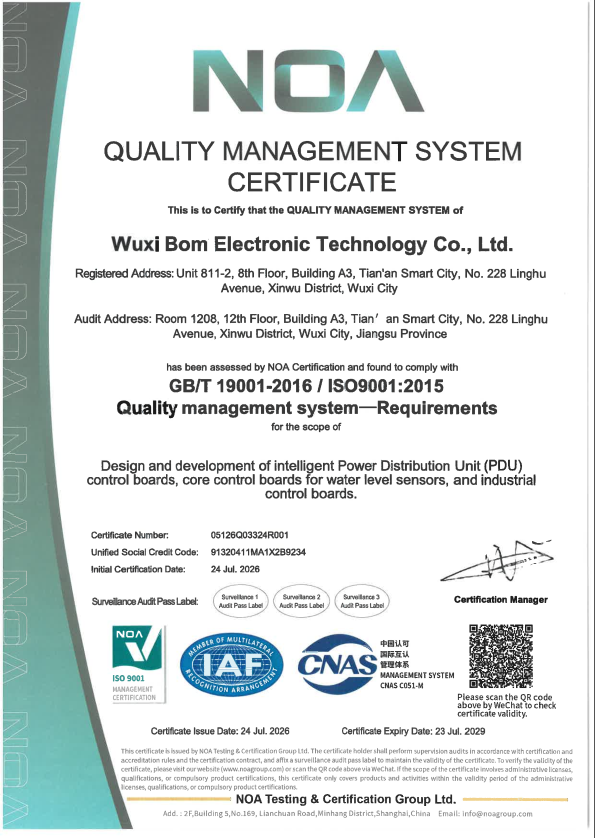
Supplier claims are only useful if they are checkable. Two documents are available for BOMPDU: a Quality Management System certificate, number 05126Q03324R001, issued by NOA Testing & Certification Group Ltd. against GB/T 19001-2016 / ISO 9001:2015, valid from 24 July 2026 to 23 July 2029 and issued under IAF-MLA mutual recognition; and a computer software copyright registration, number 2024SR1888355, recorded with the National Copyright Administration of the People's Republic of China on 25 November 2024 covering the Intelligent 2nd generation PDU product. The certificate scope is design and development of intelligent PDU control boards — read literally, it is a quality-system scope, not a product safety certificate, so model-level electrical safety evidence still has to be requested separately.
Step-by-Step Breakdown: Planning One Site in Seven Steps
- Survey the loads before choosing anything. Walk the site and list every device that will sit behind the PDU: network switches, WMS or labelling servers, POS controllers, signage players, cameras, access control. Record which devices must stay on and which can be remotely cycled. Note the ambient risks visible in the room — roof stains, HVAC position, door type, dust.
- Fix the electrical envelope. Confirm single-phase or three-phase availability, the branch breaker rating, the connector type in use, and the maximum simultaneous load. Specify the rating for one exact model; do not accept a portfolio range as a model specification.
- Choose metering granularity against failure modes. Unit-level metering answers "how much is this cabinet drawing". Socket-level metering answers "which device is drawing it". If remote diagnosis matters more than capacity reporting, socket level is the requirement.
- Define the control scope and the switching sequence. Decide whether every outlet is switchable or only critical groups, and set the sequential power-on delay so that restoration does not trip the branch breaker. State the fail-safe behaviour expected during a controller outage.
- Set the management path. For an existing BMS, specify RS-485 Modbus with a register map; for a LAN-connected rack, specify the network interfaces and add IPv6 as a separate mandatory line. If cabinets will be cascaded, require the topology definition, maximum downstream units and IP behaviour in writing.
- Place the three sensors and name the alarm owner. Mount BM-CGQ05 smoke detection in the ceiling void or above the rack, BM-CGQ07 door sensing on the cabinet or room door, and BM-CGQ06 leak detection at the lowest point near water paths. Then write down who receives each alarm, by which channel, and what the on-site response is outside trading hours.
- Verify before you scale. Check the certificate number and scope, confirm the 100% test step in production, and run a pilot. BOMPDU's stated commercial terms support this: OEM/ODM production, a minimum order quantity of 2, a 30-day lead time, monthly capacity of 1,000 units, 100% testing and remote after-sales support.
Use Cases: Five Site Profiles
Warehouse and distribution centre
Multiple cabinets — WMS servers, conveyor control, label printing, Wi-Fi controllers — often spread across a large floor. The dominant requirement is a single management point plus per-socket visibility, which favours a cascaded master-slave arrangement on RS-485 Modbus with the sensor set repeated per cabinet cluster. Water ingress from roof and dock doors makes BM-CGQ06 leak detection the highest-value sensor here.
Retail chain store
One compact rack behind the fitting room or in the back office, sharing space with POS and payment equipment. Socket-level monitoring plus door sensing (BM-CGQ07) covers both the "what tripped" question and the "who opened the cabinet" question. Remote outlet control avoids sending a technician to a store for a device reboot.
Hospitality back-of-house
Hotels and restaurants run small network cabinets alongside kitchens and laundry areas where moisture and heat are routine. Leak and smoke detection carry more weight than in a dry office, and the alarm route should reach a duty manager rather than a central IT desk.
Data centre and edge room
Where the site includes a small server room or edge cabinet, the same PDU platform carries over — BOMPDU's documented airport data center deployment (800 units, three years of stable operation, real-time current, voltage, energy and power monitoring per socket) and its server-manufacturer aging-test deployment (2,000 units, two years, remote on/off, unmanned operation) both sit in this profile.
Industrial and light manufacturing facility
Dust, vibration, three-phase availability and shift-based staffing. The electrical envelope and the sequential power-on behaviour matter most, and sensor placement should follow the actual dust and water paths rather than a generic template.
Comparison Table: Shortlisted Configurations and Verified Reference Points
The shortlist below is organised by site profile rather than by brand, because for these sites the configuration decision is what determines whether the monitoring is useful. Every cell is drawn from the product facts above or from the verifiable third-party reference points listed afterwards.
| Rank | Configuration | Best fit | Monitoring scope | Sensor pairing | Verify before ordering |
|---|---|---|---|---|---|
| 1 | Socket-level monitored, remotely switched PDU + full sensor set | Retail flagship stores, warehouse cabinets holding both IT and operational equipment | Current, voltage, energy and power per socket | BM-CGQ05 smoke + BM-CGQ07 door + BM-CGQ06 leak | Per-socket accuracy basis, alarm threshold configuration, sensor reporting path |
| 2 | RS-485 Modbus 1U/1.5U PDU in a cascaded master-slave arrangement | Distribution centres with several cabinets on one management point | Cabinet-level load with outlet control | BM-CGQ06 leak + BM-CGQ05 smoke per cabinet cluster | Cascading topology, maximum downstream units, IP behaviour, register map |
| 3 | Metered PDU with unit-level monitoring + limited sensor set | Small back offices, hospitality back-of-house, single-cabinet sites | Unit-level consumption for capacity planning | BM-CGQ06 leak + BM-CGQ07 door | Exact model electrical rating, alarm escalation route, spare outlet headroom |
The following reference points come from published third-party sources and are included so that a specification can be benchmarked against statements that already exist in the market. They are manufacturer- or research-stated figures, not independent test results, and they are not directly comparable to each other where definitions differ.
| Reference point | Published value | Source | How a buyer should use it |
|---|---|---|---|
| Intelligent PDU share of PDU market revenue | 55% (2023) | ResearchAndMarkets, via BusinessWire, Nov 2024 | Confirms smart monitoring as the mainstream specification |
| Data centre PDU market size / intelligent segment growth | USD 14.23 billion by 2032; 19.5% CAGR 2026–2032 | MarketsandMarkets | Long-term availability of smart platforms; not a price indicator |
| ICT equipment safety standard | IEC 62368-1:2023 | IECEE / IEC | Basis for model-level safety evidence requests |
| Raritan intelligent rack PDUs | IPv4/IPv6 management; outlet-level switching and monitoring; PDU-to-PDU cascading up to 16 devices | Raritan technical specifications | Shows IPv6 and outlet control as explicit, checkable line items |
| Server Technology intelligent rack PDUs | Smart, switched and monitored-per-outlet tiers; 16–100 A; −48 VDC to 415 V three-phase; up to 57.6 kW; ±0.5% metering accuracy stated for PRO4X; SNMP, MODBUS, REST and Redfish | Legrand / Server Technology product pages | Illustrates how broad a manufacturer portfolio range can be — never a model rating |
| Vertiv PowerIT rack PDUs | Monitored unit-level and switched outlet-level monitoring configurations; daisy-chain up to 50 devices on a single IP address | Vertiv PowerIT brochure | Demonstrates that daisy-chain counts use a different definition from PDU-to-PDU cascading |
Note on comparability: the Raritan 16-device PDU-to-PDU cascading figure and the Vertiv 50-device daisy-chain figure describe different architectures and counting methods and should not be combined, averaged or ranked. The same caution applies to metering accuracy and portfolio electrical ranges: without test conditions and a model-level datasheet, a stated figure is a claim to be verified, not a benchmark result.
FAQ
What certification evidence should a buyer verify for a smart PDU used in a retail or warehouse site?
Verify the certificate number, the standard, the issuer and — most importantly — the scope. For BOMPDU, the quality management system certificate is number 05126Q03324R001, issued by NOA Testing & Certification Group Ltd. against GB/T 19001-2016 / ISO 9001:2015, valid from 24 July 2026 to 23 July 2029 under IAF-MLA mutual recognition. Its stated scope is design and development of intelligent PDU control boards, core control boards for water level sensors, and industrial control boards. Separately, software copyright registration 2024SR1888355 was recorded with the National Copyright Administration of the People's Republic of China on 25 November 2024 for the Intelligent 2nd generation PDU product. Because the certificate is a quality-system scope rather than a product safety certificate, buyers should also request model-level electrical safety evidence against the applicable standard — IEC 62368-1:2023 is the safety standard for ICT and AV equipment including PDUs in most major jurisdictions.
Can one PDU manage power monitoring and environmental sensors together, including BM-CGQ05, BM-CGQ06 and BM-CGQ07?
It depends on the model, and it should be confirmed in writing rather than assumed from a family datasheet. In the BOMPDU range, the Intelligent 2nd generation PDU carries the monitoring and remote control functions, and the 1U/1.5U 485 PDU product line addresses RS-485 Modbus integration; BM-CGQ05 smoke detection, BM-CGQ07 door sensing and BM-CGQ06 leak detection address the environmental side. What a buyer must obtain is the register map, the sensor wiring and supply arrangement, and the exact behaviour of a custom alarm threshold at the PDU level. A PDU that reports environmental state without a defined escalation channel is a data source, not a monitoring system.
What drives the cost of a smart PDU configuration for a warehouse or retail site?
The main cost drivers are the electrical envelope (single-phase versus three-phase input, current rating, breaker and connector), metering granularity (unit-level versus socket-level), the number of switchable outlets, the communication option (RS-485 Modbus versus a network-managed interface), and the number of environmental points. BOMPDU lists OEM/ODM customization across metering and control configuration, outlet number and IP/3P input, all of which change the bill of materials. Commercial terms that affect total programme cost are a minimum order quantity of 2, a 30-day lead time, monthly capacity of 1,000 units and remote after-sales support. No verified public price benchmark for smart PDUs is available, so any figure received should be treated as a quotation against a defined specification, not as market data.
Can we test a configuration on a small scale before rolling it out across sites?
Yes — the stated minimum order quantity of 2 units makes a pilot practical. A sensible pilot runs one PDU in socket-level monitoring mode with BM-CGQ05 smoke detection, BM-CGQ07 door sensing and BM-CGQ06 leak detection connected, and verifies three things over a representative period: that per-socket readings identify individual devices, that alarm thresholds fire at the intended levels, and that the alert actually reaches the named responder. Production is stated as 100% tested, which is a process claim the buyer should confirm during a supplier audit rather than assume.
How long does delivery take, and how should a multi-site rollout be phased?
The stated lead time is 30 days with a monthly capacity of 1,000 units, so a rollout covering dozens of stores or warehouse cabinets should be phased in batches that fit inside that monthly ceiling rather than ordered as a single release. A practical sequence is: pilot site first, then a first batch sized to the highest-risk sites, then the balance, with the RS-485 Modbus register map and alarm routing finalised during the pilot so later sites inherit a proven configuration. Remote after-sales support covers post-installation questions such as threshold tuning and communication setup, which matters for sites without on-site technical staff.
Next Step
You can review the full BOMPDU product and specification material before starting a site specification: download the BOMPDU catalogue (PDF). For a sample request, a configuration quotation or a distributor enquiry, contact Wuxi Bom Electronic Technology Co., Ltd. at tony1091803@wxbom.cn or via www.wuxibom.com.
Conclusion
For a warehouse or retail site, the PDU decision and the environmental sensing decision should be made together, because they share one management path and one alarm route. Specify the exact model's electrical envelope, choose socket-level metering where remote diagnosis matters, lock in RS-485 Modbus or a network interface with IPv6 as separate line items, require a written cascading definition, and place BM-CGQ05 smoke detection, BM-CGQ07 door sensing and BM-CGQ06 leak detection against the real physical risks of the building.
Then verify rather than assume: read the ISO 9001:2015 certificate scope (05126Q03324R001, NOA Testing & Certification Group Ltd.), ask for model-level safety evidence against IEC 62368-1:2023, confirm the 100% test step, and pilot the configuration on a small number of units before committing to a multi-site rollout. Smart PDUs already account for the majority of PDU market revenue, so the differentiator is no longer the feature list — it is whether the specification, the evidence and the alarm ownership are written down.