18
11/2026
Smart PDU Long-Term Supply: Terms, Acceptance, After-Sales FAQ
Long-term smart PDU supply FAQ: MOQ, 30-day lead time, 1,000-unit monthly capacity, FOB and 30/70 terms, pre-shipment acceptance criteria, relay logs, and ISO 9001:2015 scope limits.
Smart PDU Long-Term Supply: Purchasing Terms, Acceptance Criteria, and After-Sales FAQ
Short answer: a long-term smart PDU programme is held together by three documents, not by a product page. The first fixes commercial terms: MOQ, typical lead time, capacity, delivery term, payment split and price validity. The second defines acceptance, meaning the pre-shipment tests that decide whether a batch conforms and the records that prove it. The third covers after-sales: what happens when a relay reaches its cycle count, an alarm threshold has to change, or a model approaches end of life.
BOMPDU (Wuxi Bom Electronic Technology Co., Ltd.) publishes an MOQ of 2 units, a typical production lead time of 30 days and monthly production capacity of 1,000 units, and holds ISO 9001:2015 certificate number 05126Q03324R001, issued by NOA Testing & Certification Group Ltd., covering intelligent Power Distribution Unit control-board design and development for the global market. This FAQ sets out what to verify in each of those three documents, and where the certificate's authority stops.
Why repeat PDU orders fail on paperwork, not on product
The first shipment of a smart PDU programme is usually judged by engineers. The fifth shipment is judged by whoever receives it. That is where long-term supply breaks: a connector type changes, a firmware baseline moves, an alarm default stays at the factory value, and the 'same' PDU no longer matches the rack documentation.
'Smart PDU' is not a specification, and public product documentation shows how wide the label is. Server Technology describes its intelligent rack PDUs across smart, switched and monitored-per-outlet configurations; Vertiv's PowerIT documentation separates monitored unit-level from switched outlet-level monitoring. Those are different products with different switching and measurement behaviour, and a purchase order reading 'network managed PDU' does not tell a supplier which of them to build.
Network capability repeats the pattern. Raritan states IPv4/IPv6 management on its intelligent rack PDUs; Server Technology lists SNMP, MODBUS, REST-based APIs and Redfish on its PRO4X line. Protocol coverage differs between manufacturers and between models from the same manufacturer, so IPv6 support, Modbus register maps and API availability belong on their own lines of a technical annex, not inside the phrase 'remote control PDU'.
Cascading is the clearest example of a term that looks comparable and is not. Raritan states PDU-to-PDU cascading of up to 16 devices; Vertiv states that up to 50 devices can be daisy-chained behind a single IP address. Both are manufacturer statements, but they count different things. A contract should name the topology, the maximum downstream unit count, the IP-address behaviour and the controller requirement instead of accepting a device count on its own.
What the ISO 9001:2015 certificate covers, and what it does not
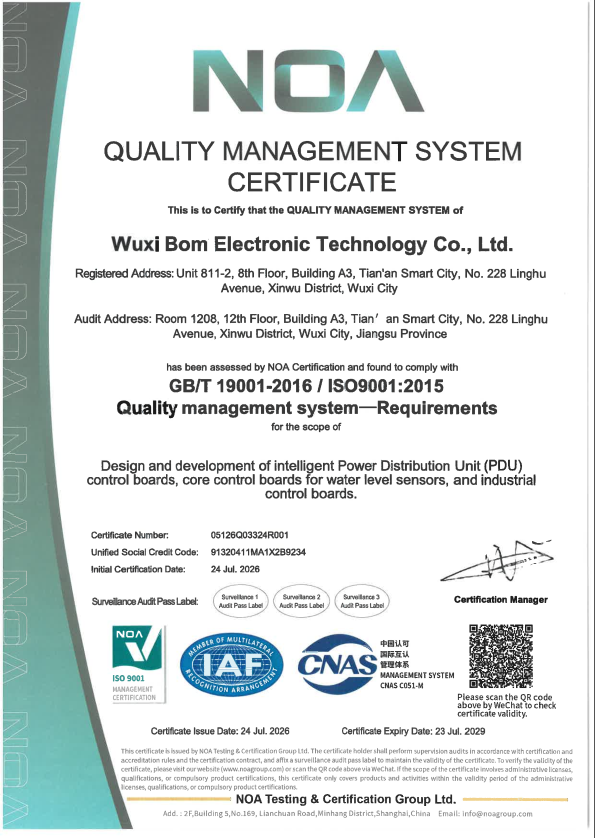
The certificate that anchors the quality discussion is ISO 9001:2015, certificate number 05126Q03324R001, issued by NOA Testing & Certification Group Ltd. Its stated scope covers intelligent Power Distribution Unit control-board design and development for the global market.
Read the scope closely, because it sets the useful boundary. A quality-management registration of this type addresses how the in-scope design and development work is planned, reviewed, verified and recorded: design inputs and outputs, review points, verification steps, change control and record retention. It is evidence of process discipline in control-board design work.
It is not a product safety certificate, not a type test of a finished PDU, and not a warranty. It does not state that any specific model meets a particular electrical safety standard, and it says nothing about how long a relay will last in a live rack. A buyer who treats a QMS certificate as a substitute for model-level test evidence ends up with an acceptance process that cannot reject anything.
Safety is a separate question with a separate evidence trail. IECEE lists IEC 62368-1:2023 as the safety standard for ICT and AV equipment, the equipment family that rack PDUs sit in, in most major jurisdictions. Whether that standard, or a national variant of it, applies to a specific deployment is a market question for the buyer's compliance team. The procurement move is to name the required standard and conformity mark in the technical annex and ask the supplier to confirm the evidence it can provide, rather than assuming the QMS certificate answers it.
The certificate itself is worth re-verifying once a year: certificate number, standard version (2015), issuing body, exact scope wording, and current validity of the registration. Scope wording is where most misreading happens. A registration covering control-board design and development is not a registration covering every assembled unit that leaves the factory, and tender documents should not be written as though it were.
Company context shows how that scope is staffed. Wuxi Bom Electronic Technology Co., Ltd. was established in 2018, is based in Wuxi, Jiangsu Province, and lists 70 employees, a 12-engineer R&D team and more than ten invention patents for PDU products. Its main products are the Intelligent 2nd generation PDU and the 1U/1.5U RS485 PDU, with main markets listed as the USA, Southeast Asia, the EU and the Middle East. For a multi-year programme, ask which engineers own control-board changes and how a requested alarm-threshold or protocol change is quoted, validated and released.
Purchasing terms to fix before the first purchase order
Six commercial parameters cause most friction across a multi-year agreement: MOQ, lead time, capacity and allocation, delivery term, payment split, and price validity with change control. Each takes a paragraph to write, and each causes disputes when it is left as a general understanding.
MOQ, lead time and capacity
BOMPDU's published terms state an MOQ of 2 units, a typical production lead time of 30 days and monthly production capacity of 1,000 units. The website version of that statement is tied to the EU and Middle East markets, so confirm applicability for other destinations before it becomes a contract figure.
MOQ is also configuration-specific in practice. Configuration-level purchasing records for particular smart PDU builds document MOQ figures of 10, 70 and 100 units alongside the published 2-unit term. The practical reading is that MOQ belongs to a model and a market rather than to a supplier as a whole: a framework agreement should name the model, its MOQ, the applicable market and the validity period, so that the fifth order does not restart the negotiation.
Lead time needs the same precision. Thirty days is a typical figure, not a commitment, and it only means something once the start point is defined: purchase order plus deposit plus approved configuration, or approved first article. Write the trigger down, and write the schedule consequence of a failed acceptance test separately, because rework, retest and re-presentation time is normally additional to the quoted figure.
Capacity is the term buyers under-use. A programme that needs 600 units in one month is already working against a stated 1,000-unit monthly capacity, and a programme that needs more has to be planned with the supplier rather than assumed. Ask for a written allocation statement per quarter and a notification obligation if competing orders affect the agreed schedule.
Delivery term and payment split
The documented terms in the purchasing records are FOB delivery and a 30/70 payment split, with pre-shipment testing as the acceptance basis. Two details are worth adding at the execution stage. Under FOB, the buyer arranges and pays for main carriage and insurance and bears risk from loading, so inbound logistics belong in the buyer's own plan. And the 30/70 split should be tied to milestones the buyer can verify, typically deposit on order and balance against release of pre-shipment test documentation, rather than to a calendar date alone.
Price validity and change control
A long-term price is a price with rules attached: a stated validity window, a stated review mechanism and a stated notice period before any change. Engineering change control matters more than price mechanics. Specify that no change to the control board, firmware baseline, connector or outlet configuration, alarm defaults or protocol map ships without written notice and re-acceptance, and that the changed configuration can be sampled for verification. Add a spare-parts and last-time-buy clause, so that end of life for a model is a planned event with a notice period rather than a surprise in year three.
Acceptance criteria: what to test before shipment
Acceptance should mean one thing in the contract: a documented pre-shipment test against an agreed checklist, with records traceable to serial numbers. The ISO 9001 registration is a control on process; acceptance is a control on the batch. A long-term buyer needs both, and neither replaces the other.
- Lock the configuration baseline. Model name, phase configuration including whether single/three-phase switchability is part of the model, inlet and outlet types, monitoring level (unit-level or socket-level), switching capability, alarm defaults, protocol set and firmware version. Anything not written down is a variable.
- Agree the test scope in writing. Power-on and functional check, outlet-level switching where the model provides it, sequential power-on timing where that is a specified function, alarm behaviour, and communication over RS485 and/or the network. The test document should state pass/fail limits, not simply 'tested'.
- Prove the alarm chain, not only the alarm. BOMPDU's documented overload control uses a dual-level mechanism on sub-control units: a primary alarm as current approaches the rated value, and a secondary alarm at overload, fed back over RS485 or the network. Acceptance should confirm that configured thresholds match the agreed custom alarm threshold values, and that the alarm actually reaches the monitoring system you will operate.
- Check relay control and its logs. Relay life is managed through relay status monitoring and cycle control: control logs for sub-control unit relays are recorded and analysed to track action status and service life. Ask for an export of that log as part of acceptance. It is the difference between a claim about relay management and a usable maintenance record.
- Handle metering accuracy carefully. If an accuracy figure is quoted, ask for the measurement basis, operating range, uncertainty and test conditions behind it. Accuracy statements across the category are not comparable without those conditions, so acceptance should record what was measured, with which instrument, at which load.
- Export the configuration and the serial list. A configuration file, register map and per-serial test record are what make the second order reproducible. Without them, 'same as last time' is an assumption rather than an instruction.
- Close non-conformances formally. Define what happens when a unit fails: rework and retest, replacement, credit, or re-presentation of the batch, and who bears the schedule cost. Acceptance without a non-conformance path is a formality.
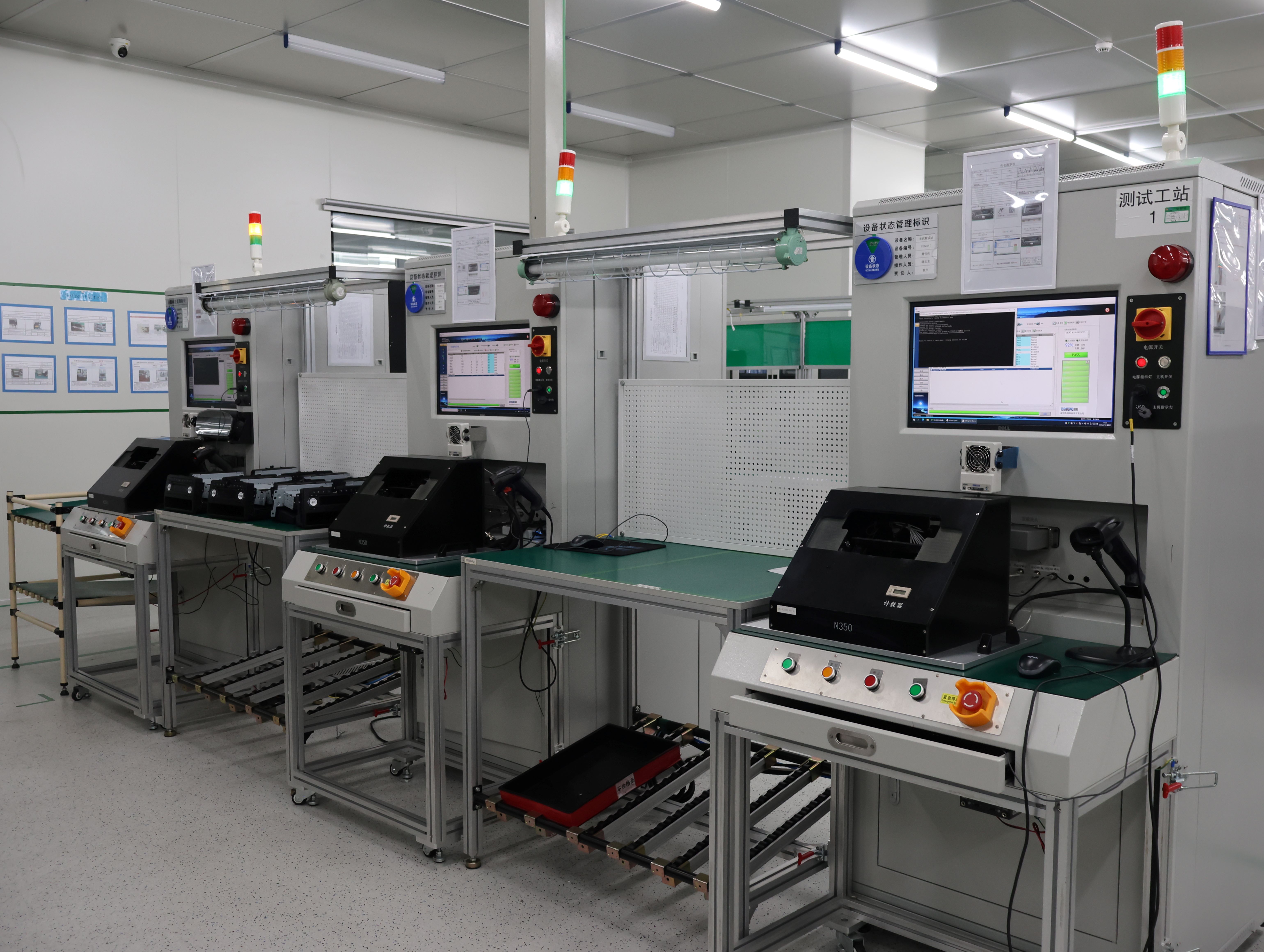
One boundary worth stating plainly: a pre-shipment test is not a reliability demonstration. Factory assets documented in the company's materials include a burn-in test system, a high-low temperature test chamber and functional testing stations, and these support consistency in production. They do not convert into a field-life figure that a supplier can promise. If a programme needs a reliability number, that has to be a separately agreed test with its own conditions and sample size.
Verification matrix: what each document actually proves
The table maps the evidence a long-term buyer normally collects to what it establishes, and to the assumption it does not support. Read the third column before accepting any item in the first two.
| Evidence | What it verifies | What it does not establish |
|---|---|---|
| ISO 9001:2015 certificate 05126Q03324R001, issued by NOA Testing & Certification Group Ltd. | A registered quality management system covering intelligent PDU control-board design and development for the global market | Product safety conformity, model-level performance, or warranty duration |
| Pre-shipment test report per serial number | The tested units met the agreed test scope and limits at the time of test | Performance of untested units, or long-term field reliability |
| Relay action and cycle log | Recorded relay action status and service-life tracking per sub-control unit | That a relay cannot fail before the logged estimate |
| Alarm threshold configuration record | Primary and secondary overload alarms were set to the agreed values and reported over RS485 or the network | Accuracy of the current-sensing chain |
| Metering accuracy statement plus calibration method | The declared accuracy, together with its measurement basis and conditions | Comparability with another supplier's accuracy figure |
| Firmware version and configuration export | A reproducible baseline for repeat orders and change control | Cyber-security hardening or network approval in your environment |
After-sales: what to negotiate while the order is still open
After-sales is where long-term relationships are usually assumed rather than documented. The stated position here is a well-established after-sales support system, which is a company-level description rather than a service-level commitment. The commitment has to be built into the contract, and five items do most of the work.
- Support channel and response target. Name the route (email, phone, WhatsApp) and a first-response target for critical and non-critical cases separately. A target without a channel and a named escalation contact is not usable at two in the morning.
- Remote diagnosis before dispatch. A network managed PDU with socket-level monitoring gives per-outlet current data; the dual-level overload alarm reports approaching-rated-current and overload conditions over RS485 or the network; relay logs show action counts on each sub-control unit. Together these let a support team decide whether the issue is a load, a relay or a network path before anyone ships a replacement.
- Spare parts and replacement units. Agree the spare-parts availability window for the model, whether advance replacement is available, and the RMA process, including who pays freight on a confirmed defect.
- Firmware and configuration support. State how long firmware for the model will be maintained, how updates are distributed, and whether configuration backups are held by the supplier or by the buyer.
- Warranty in writing. Duration, what is covered, what is excluded, and how the start date is calculated. If the offer documents do not state a warranty period, treat it as an open commercial term to negotiate rather than an implied promise. A quality-management certificate supports confidence in process; it does not define warranty scope.
Three long-term supply scenarios and what each one needs
Phased data centre expansion. Orders arrive hall by hall over several years, and the risk is configuration drift between halls. Fix one baseline, require the same pre-shipment test per batch, quote capacity per quarter against the 1,000-unit monthly figure, and keep one documentation pack per hall so that maintenance staff work from a single register map and alarm default list.
Multi-site edge and industrial cabinets. Loads and environments differ by site, so decide once whether the deployment needs unit-level monitoring or socket-level visibility, then standardise. Custom alarm thresholds should be set per site type rather than per unit, environmental monitoring should be specified alongside power monitoring, and a regional spare kit plus a documented replacement procedure is usually worth more than a longer warranty argument.
Integrator or stocking programme. The commercial risk shifts to inventory. MOQ, price validity, allocation and the after-sales escalation path carry more weight than feature lists. Consistent labelling and documentation across batches matters here too, because the integrator's own field team and its end customer both work from the same paperwork.
FAQ: long-term smart PDU supply
Which compliance documents should a long-term buyer keep on file?
Three, kept together. First, the ISO 9001:2015 certificate (number 05126Q03324R001, issued by NOA Testing & Certification Group Ltd., scope: intelligent Power Distribution Unit control-board design and development for the global market). Second, the market-specific safety evidence named in your technical annex; IEC 62368-1:2023 is the reference IECEE lists for ICT and AV equipment in most major jurisdictions. Third, the pre-shipment test report for each serial number shipped. The certificate evidences a registered management system within its scope. It does not evidence product conformity, so it cannot stand alone in a tender file.
Can supply keep pace with a repeat-order programme?
Published capacity is 1,000 units per month, with a typical lead time of 30 days and an MOQ of 2 units. For a programme that consumes a large share of monthly capacity, ask for quarterly allocation confirmation, a batch schedule, and written notification if another order affects your dates. A capacity statement describes production; a reservation is a contract term you have to request.
How are overload and relay-life risks handled after installation?
Through two documented controls. Overload protection uses a dual-level alarm on sub-control units: a primary alarm as current approaches the rated value and a secondary alarm at overload, reported over RS485 or the network. Relay life is managed through relay status monitoring and cycle control, with action status and service life tracked through control-log analysis. For long-term operations, ask for log access and agree a replacement threshold before failures happen, not after.
What commercial terms apply, and what still has to be negotiated?
The documented terms are an MOQ of 2 units, FOB delivery, a 30/70 payment split and pre-shipment testing as the acceptance basis, with configuration-level records showing MOQ figures of 10, 70 and 100 units for specific builds. Warranty duration, response times, spare-parts horizon and price validity are not set by those terms and must be negotiated into the agreement.
Can we validate before committing to a framework order?
A published MOQ of 2 units makes a small validation order commercially realistic. Define in advance what the sample must demonstrate: protocol integration with your monitoring stack, alarm behaviour at agreed thresholds, sequential power-on timing if the model specifies it, outlet-level switching if that is in scope. Then treat the sample's configuration record as the baseline for the framework agreement. A sample that passes an undefined test proves nothing about the batch that follows it.
What lead time should the contract state?
Thirty days is the typical figure. Contract language should define the start trigger, separate the first-article approval stage from the production stage, and state what happens to the delivery date if a batch fails acceptance. For configured products, such as alarm threshold sets, phase configuration or protocol options, add the configuration step to the schedule rather than assuming it runs inside the 30 days.
What after-sales commitments are documented, and what should we write in?
The company profile states a well-established after-sales support system, which is a company-level description rather than a service-level commitment. Put the usable terms into the contract: support channel and first-response targets, escalation contact, RMA and freight responsibility, advance-replacement availability, spare-parts horizon, firmware maintenance period, and warranty duration with its start date and exclusions. To discuss a specific programme, contact Tony at tony1091803@wxbom.cn or +86 18751550927; the smart PDU catalogue and company profile are available through the download link below.
Long-term supply is an evidence habit, not a promise
A supplier relationship that survives several years is one where both sides can point to the same documents. The ISO 9001:2015 registration, with its defined scope over intelligent PDU control-board design and development, tells a buyer that design work runs inside a managed process. It does not tell them what a specific unit will do at 42 degrees, how long a relay will last, or what happens when a model is discontinued. Those answers come from the commercial terms, the acceptance test and the after-sales clause, written before the first purchase order rather than after the first failure.
The minimum a buyer should leave the negotiation with: a named model with its MOQ and market stated, a start trigger for the 30-day lead time, a quarterly capacity statement, an acceptance test with pass/fail limits and per-serial records, relay and alarm evidence tied to the agreed thresholds, and a written after-sales clause covering response, replacement, spares and warranty. Everything else is a preference. These six are the programme.
Next step: review the smart PDU range and the company's quality documentation before drafting your technical annex.
Download the BOMPDU smart PDU catalogue and company profile (PDF)
Contact: Tony | tony1091803@wxbom.cn | +86 18751550927 | WhatsApp +1 (786) 989-2761