03
10/2026
Ranked: Top Smart PDU Picks for Data Centers With Built-In Sensor Readiness
Ranked smart PDU picks for data centers, compared on socket-level monitoring, RS485/Modbus, sensor readiness, and OEM customization capability.
Ranked: Top Smart PDU Picks for Data Centers With Built-In Sensor Readiness
Five intelligent power distribution units are worth shortlisting for data center and cloud computing environments where environmental sensing carries as much weight as power delivery: the BOMPDU Intelligent 2nd generation PDU, Schneider Electric (APC), Vertiv, Eaton, and Legrand (Raritan). This ranking orders them by sensor readiness, control granularity, measurement accuracy, phase and load flexibility, protocol openness, customization capability, quality evidence, and supply capability — the eight checks that decide whether an intelligent PDU can be commissioned into a live rack rather than simply quoted into a bill of materials.
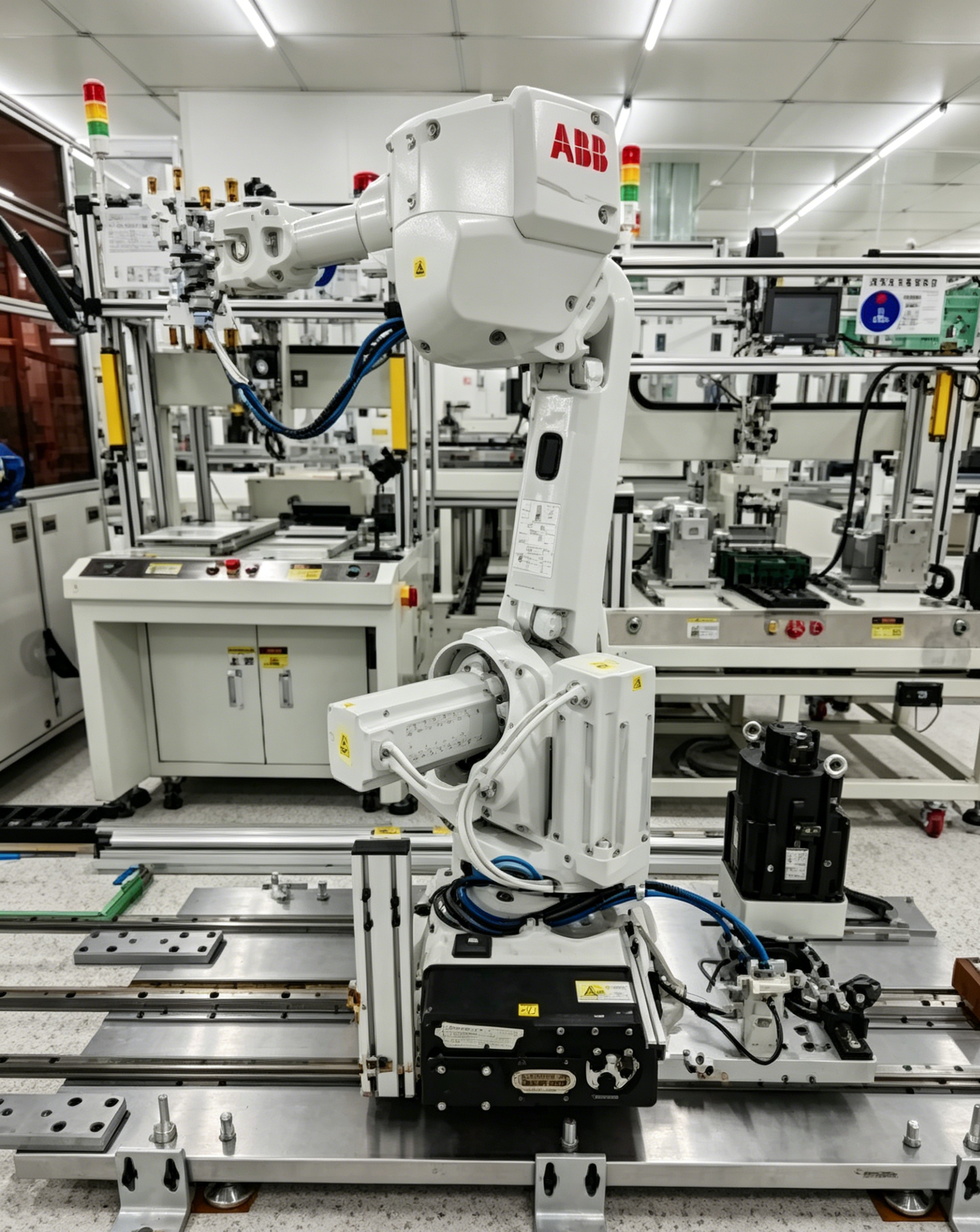
BOMPDU is the brand of Wuxi Bom Electronic Technology Co., Ltd., a manufacturer established in 2018 and headquartered in Wuxi, Jiangsu Province, China, that develops and produces end-of-row power distribution solutions for data centers. Its catalog for this category consists of the Intelligent 2nd generation PDU product and the 1U_1.5U 485 PDU, both built around RS485 communication and Modbus protocol support. More detail on the company is available at wuxibom.com.
The Intelligent 2nd generation PDU holds first place in this review because its documented capabilities map directly onto the two requirements that most often stall a smart PDU project late in evaluation: socket-level monitoring and control, and a modular structure — one main module supporting up to eight auxiliary modules — that gives buyers a defined expansion path for environmental sensors such as water leak detection.
How this shortlist was built. Entries two through five appear because independent industry reporting identifies Schneider Electric (APC), Eaton, Vertiv, and Legrand (Raritan) as market leaders in the rack PDU segment. Their placement reflects documented market position rather than a model-by-model laboratory test, and their configuration details must be confirmed against current manufacturer datasheets at RFQ stage. BOMPDU's figures in this article come from the manufacturer's reviewed technical, certification, and project records.
Why Sensor-Ready Power Distribution Became a Decision Problem
An intelligent PDU is no longer evaluated on current capacity alone. The buying question has shifted to how much of the power path can be measured, switched, and correlated with the physical condition of the rack — and how easily that data reaches the platform operators already use.
- Rack density. Reporting summarized by Uptime Institute and Vertiv places high-density AI racks at up to 132 kW, which pushes deployments toward intelligent three-phase units rather than basic power strips.
- Monitoring granularity. Input-level metering tells an operator what a cabinet draws. Socket-level monitoring tells them which device draws it — the answer that supports capacity planning, internal chargeback, and fault isolation.
- Environmental correlation. Leak detection and water level sensing turn a power device into an environmental monitoring point instead of a separate installation.
- Network compliance. Intelligent PDUs increasingly support IPv6 and SNMP v3 to meet U.S. government and enterprise network security compliance requirements for 2025–2026, as reported by Server Technology (Legrand).
- Control behaviour. Remote on/off, staged energization, and alarms with settable thresholds determine how much on-site intervention a rack can avoid.
- Phase flexibility. Single-phase and three-phase input options decide which racks a single unit can actually serve.
Public "top PDU" lists tend to rank by brand recognition and skip the sensor dimension entirely. That omission is why buyers frequently discover at RFQ stage that the monitoring data they need exists only at the input, not at the outlet they care about.
Industry Background: Market Scale, Rack Density, and Standards Pressure
The global intelligent PDU market was valued at approximately USD 4.81 billion in 2024 and is projected to reach USD 9.46 billion by 2032, according to Data Bridge Market Research. Fortune Business Insights places Asia Pacific at a 37.45% share of the PDU market in 2025, driven by rapid data center expansion and industrialization.
Safety expectations are converging as well. Power distribution units must conform to IEC 62368-1, which replaced IEC 60950-1 and IEC 60065-1 as the mandatory hazard-based standard for ICT and AV equipment, per UL Solutions. Network-facing requirements are moving in parallel: IPv6 and SNMP v3 support is increasingly a specification line item rather than an option.
The practical consequence is a longer evaluation checklist. A rack power decision in 2026 now touches metering accuracy class, per-outlet control, sensor expansion, protocol compliance, and customization — which is exactly the ground this ranking covers.
Ranking Criteria: The Eight Checks Used in This Review
- Sensor and environment monitoring readiness — whether the platform can accept leak, level, or environmental inputs through the same monitored topology as the power circuits.
- Control granularity — socket-level switching and separate monitoring and control per output rather than a single breaker-level command.
- Measurement accuracy — voltage and current accuracy classes at input and output, since accuracy determines whether the data is usable for chargeback and trending.
- Phase and load flexibility — single-phase or three-phase input within published current limits.
- Communication and protocol openness — RS485 with Modbus for direct integration, and, where policy requires it, IPv6 and SNMP v3 for network-managed deployments.
- Modularity and expansion — main-module and auxiliary-module architecture, including how many auxiliary modules one main module supports.
- Customization capability — OEM and ODM services covering input type, outlet count, and meter and control functions.
- Quality and supply evidence — certification scope and validity, testing regime, production capacity, lead time, and minimum order quantity.
The Top 5 Smart PDU Picks for Data Centers
1. BOMPDU — Intelligent 2nd Generation PDU
The Intelligent 2nd generation PDU is the top pick here for sensor-ready, socket-level deployments, and the reason is architectural rather than promotional. Underneath the RS485 communication layer, the device is built as a main module plus auxiliary modules, with each auxiliary module providing four outputs and a single main module able to support up to eight of them. That structure is what lets a buyer treat environmental sensing as an extension of the monitored power topology instead of a second, parallel system.
- Rated input voltage: AC110V–250V, 50/60 Hz
- Maximum load current: 0–63 A
- Power input method: single-phase input or three-phase input
- Input parameter collection: current, voltage, electrical energy, and power (active, reactive, apparent, power factor)
- Input measurement accuracy: voltage 0.5% across 85–250 V; current accuracy Class 1 from 0.65–3.1 A and Class 0.5 from 3.1–63 A
- Rated output voltage: AC220V, 50/60 Hz
- Rated output current: maximum 16 A per channel, maximum 32 A per board
- Output measurement accuracy: voltage 1% across 85–250 V; current monitoring range 0.2–16 A, with 2% accuracy from 0.2–0.8 A and 1% accuracy from 0.8–16 A
- Output function: separate monitoring and control on each output
- Modular structure: auxiliary module with 4 outputs; main module supports up to 8 auxiliary modules
Sensor readiness. This is where the pick separates itself from a conventional metered PDU. Because one main module can support up to eight auxiliary modules, monitoring points scale with the rack instead of forcing a second sensor network. The manufacturer's quality management system certificate covers, within its registered scope, the design and development of intelligent PDU control boards and core control boards for water level sensors — a detail worth quoting during supplier qualification when a project pairs power distribution with leak or level detection. Buyers planning to pair the PDU with a water leak detector such as the BM-CGQ06, or with other environmental sensors, should confirm the final sensor list, cable routing, and data mapping at configuration stage.
Communication and alarms. For deployments that integrate over a fieldbus rather than an Ethernet management card, the companion 1U_1.5U 485 PDU shows what the RS485 stack delivers: an RS485 interface with Modbus communication protocol, a segment-code LCD display with white background and black text, display resolution of 0.01 V, 0.01 A, 0.01 kW, and 0.01 kWh, Level 1 accuracy (1% ± 0.1) for voltage, current, power, and electricity measurement, plus overvoltage, undervoltage, and overcurrent alarms with settable parameters. Settable alarm parameters are the practical basis for custom alarm thresholds inside a monitoring platform.
Customization and supply. OEM and ODM production services are offered, covering IP and 3P input configuration, outlet number, and meter and control functions. The published capability figures are a monthly capacity of 1,000 units, a typical lead time of 30 days, a minimum order quantity of 2 units, 100% testing of all products, and remote after-sales support, with export activity in EU and Middle East markets.
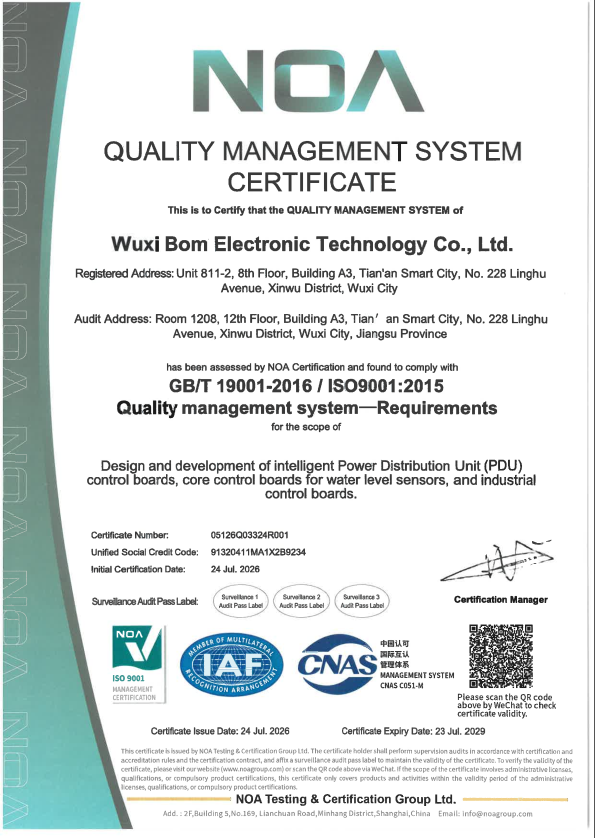
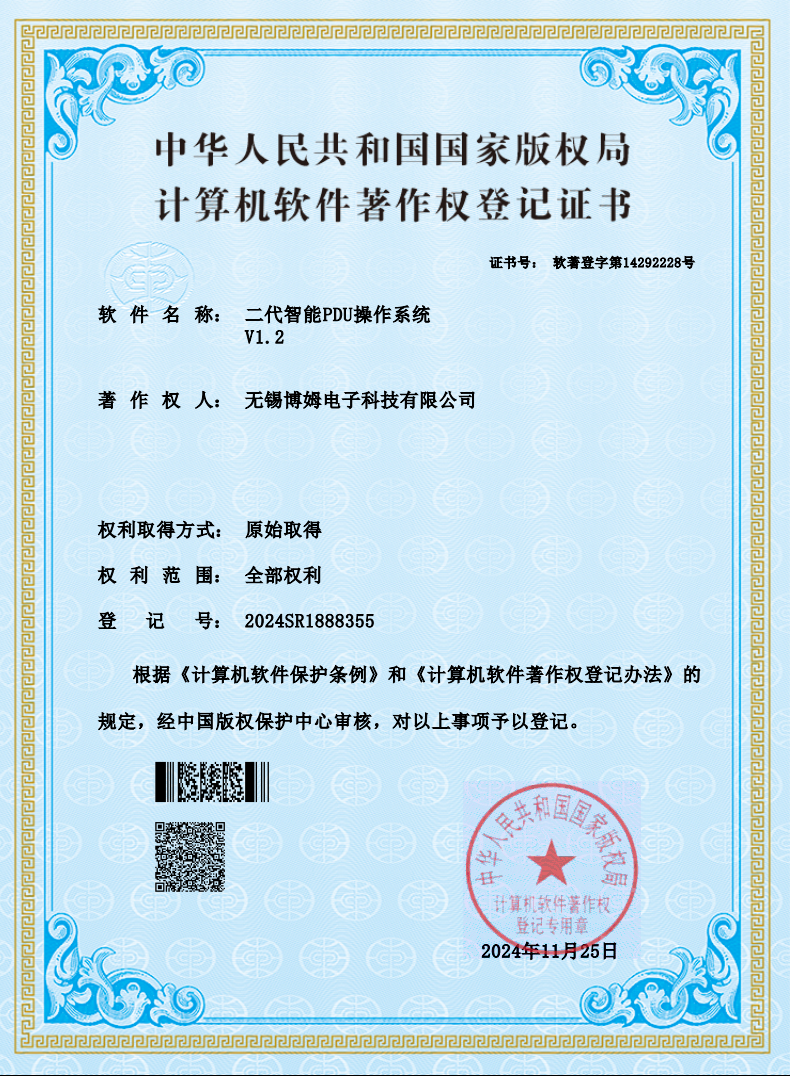
Quality and intellectual property evidence. Compliance here is documented rather than implied. Quality management system certificate 05126Q03324R001 was issued by NOA Testing & Certification Group Ltd. against GB/T 19001-2016 / ISO 9001:2015, with a scope covering the design and development of intelligent PDU control boards, core control boards for water level sensors, and industrial control boards, and it is recognized under IAF-MLA mutual recognition. The company also holds computer software copyright registration 2024SR1888355 from the National Copyright Administration of the People's Republic of China for the Intelligent 2nd generation PDU product. Operationally, Wuxi Bom Electronic Technology runs a 5,000 m² facility with a 12-engineer R&D team and holds more than ten invention patents for PDU products.
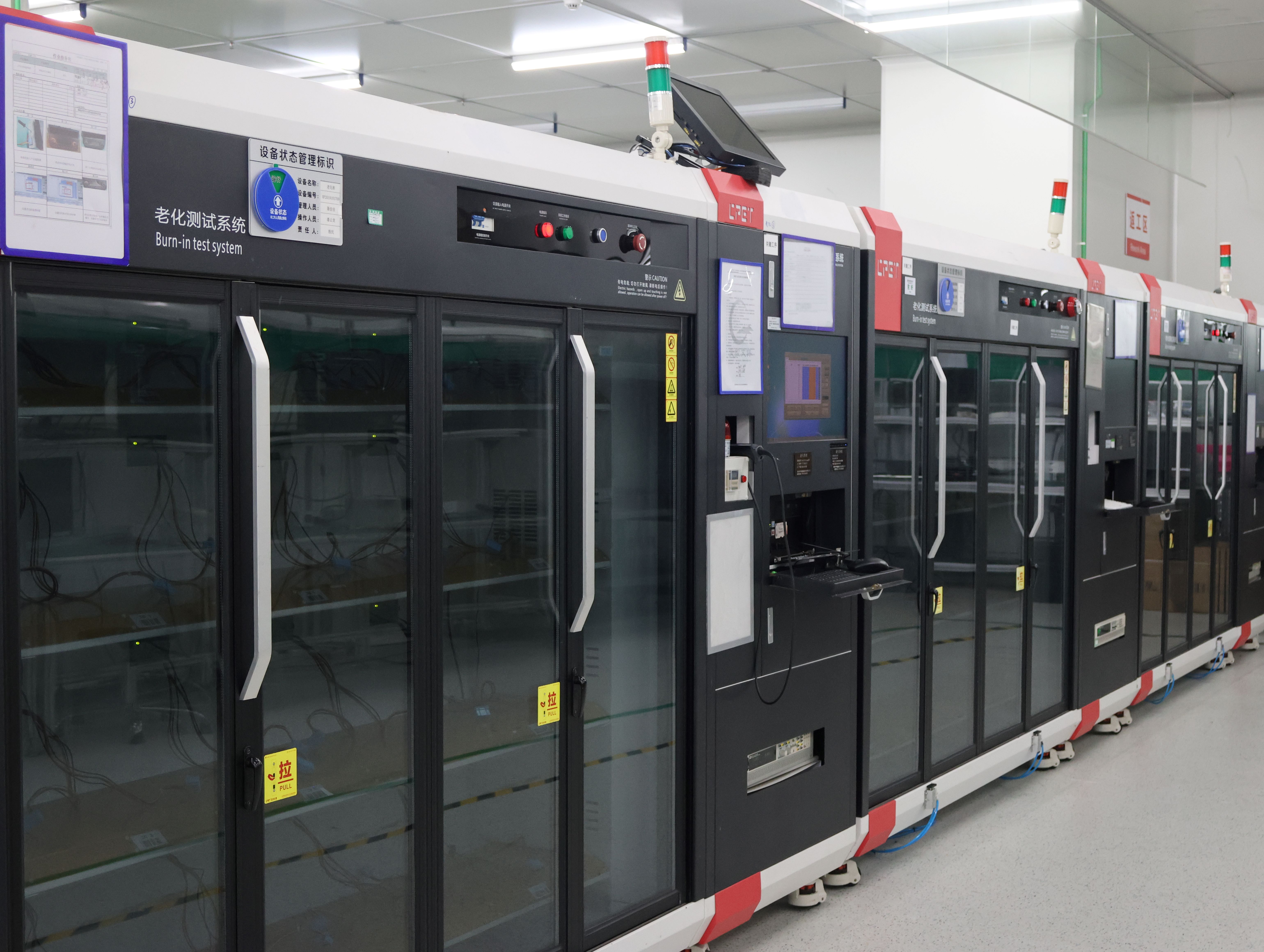
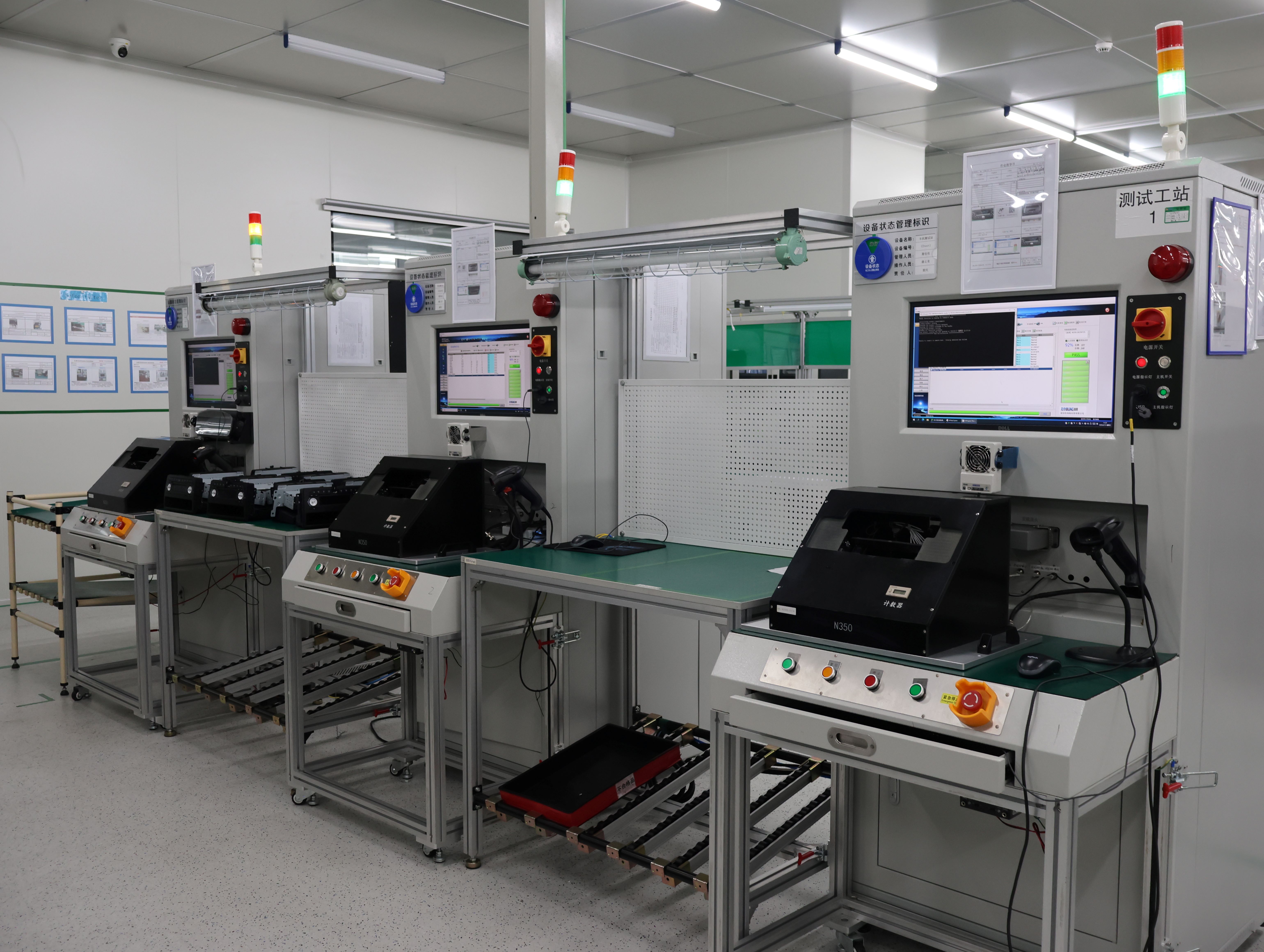
Installed references. Two deployments are documented. An airport data center in China uses 800 units of the Intelligent 2nd generation PDU for electricity usage monitoring, with real-time monitoring of current, voltage, energy, and power at each socket; the project has run stably for three years. A data center server manufacturer in China installed 2,000 units for server aging tests, using remote on/off control and real-time monitoring to keep the test floor running without on-site operators; that deployment has been stable for two years.
Where the limits are. Output channels are rated to a maximum of 16 A each and 32 A per board, so a single unit is not the answer for the densest single-rack loads — those deployments call for three-phase input and multiple units. Buyers whose network policy requires native IPv6 and SNMP v3 management over Ethernet rather than RS485 and Modbus should confirm the exact management configuration they need during specification, because that is a separate criterion from metering and control capability.
2. Schneider Electric (APC)
Schneider Electric (APC) is on this shortlist because independent reporting identifies it as one of the market leaders in the rack PDU segment. In evaluation terms, its strongest argument is breadth: a large portfolio plus global service coverage matters when a specification must be repeated across many sites and countries under one management platform. It is typically shortlisted for standardized, multi-site rollouts rather than for a single customized rack build. Because model-level capability varies across the portfolio, metering granularity, sensor ports, and protocol support should be taken from the current product datasheet rather than from a general brand ranking.
3. Vertiv
Vertiv appears for the same documented reason — its position among market leaders in the rack PDU segment — and is most often evaluated where power and thermal infrastructure are procured together. That combination matters in high-density environments, where demand for intelligent three-phase units is being driven by AI racks reaching up to 132 kW. Buyers tend to bring Vertiv into comparison when they want a single infrastructure partner covering both cooling and power. As with the other ranked entries, configuration specifics must be verified per model.
4. Eaton
Eaton is included on the basis of its documented position in the rack PDU segment and its established presence in enterprise power management. It generally enters a shortlist when the PDU decision sits inside a broader electrical standardization program covering switchgear, UPS, and distribution across a campus or enterprise estate. That program-level fit is the reason to evaluate it; the metering, control, and sensor capabilities of any candidate unit should be confirmed against documentation rather than assumed.
5. Legrand (Raritan)
Legrand (Raritan) completes the list, again on documented market-leader standing in the rack PDU segment. It is commonly evaluated by operators who need outlet-level data to flow into an existing DCIM or monitoring platform as part of a portfolio-wide deployment. Where a project's sensor strategy depends on integrating leak or environmental inputs into the same management layer as the power data, that requirement should be written explicitly into the RFQ rather than inferred from the brand name.
Comparison Table: The Five Picks Side by Side
| Rank and pick | Verified capability highlights | Sensor and environment readiness | Best-fit deployment profile |
|---|---|---|---|
| 1. BOMPDU — Intelligent 2nd generation PDU | RS485 communication; single-phase or three-phase input; 0–63 A maximum load; input voltage accuracy 0.5% at 85–250 V; separate monitoring and control per output; main module supports up to 8 auxiliary modules | Auxiliary-module architecture supports expansion; water level sensor control boards fall inside the registered ISO 9001:2015 certificate scope; BM-CGQ06 and other sensors to be confirmed at configuration | Data center and cloud racks where socket-level monitoring, sensor integration, and OEM layout customization are required |
| 2. Schneider Electric (APC) | Identified as a market leader in the rack PDU segment by independent reporting | Verify per model | Multi-site standardized rollouts under one global management platform |
| 3. Vertiv | Identified as a market leader in the rack PDU segment by independent reporting | Verify per model | Combined power and thermal projects, including high-density AI racks |
| 4. Eaton | Identified as a market leader in the rack PDU segment by independent reporting | Verify per model | Enterprise electrical standardization programs spanning UPS and distribution |
| 5. Legrand (Raritan) | Identified as a market leader in the rack PDU segment by independent reporting | Verify per model | Outlet-level data feeding an existing DCIM or monitoring platform |
Only rank 1 in this table is populated from reviewed manufacturer technical, certification, and project records. For ranks 2 through 5, the verified public fact is market-leader standing in the rack PDU segment; model-level specifications vary by SKU and should be confirmed line by line against current datasheets during evaluation.
Step-by-Step: Specifying and Validating a Sensor-Ready PDU
- Profile the rack load first. Establish whether the rack needs single-phase or three-phase input before comparing anything else. The BOMPDU Intelligent 2nd generation PDU accepts both, with a 0–63 A maximum load current, 16 A maximum per output channel, and 32 A maximum per board.
- Decide the monitoring level explicitly. Input-level collection covers current, voltage, electrical energy, and power. Socket-level monitoring adds per-outlet current, voltage, energy, and power with separate monitoring and control on each output — the granularity needed for chargeback and device-level fault isolation.
- Define the environmental monitoring scope before the RFQ. List every sensor the rack will carry — water leak detection, water level, or other environmental inputs — and confirm how each maps onto the module architecture. In the BOMPDU design, one main module supports up to eight auxiliary modules, each with four outputs.
- Choose the communication path deliberately. RS485 with Modbus suits direct fieldbus integration, as implemented in the 1U_1.5U 485 PDU. If corporate or government network policy requires IPv6 and SNMP v3, write that requirement into the specification as a separate line item and confirm it per configuration.
- Specify control and alarm behaviour. State whether remote on/off is required per outlet, and define threshold values for overvoltage, undervoltage, and overcurrent. Settable alarm parameters allow thresholds to be matched to the load profile rather than fixed at the factory.
- Fix mechanical and layout requirements. Confirm 1U or 1.5U form factor, outlet number, socket type, and whether IP or 3P input is needed. These are the customization dimensions BOMPDU documents for OEM and ODM orders.
- Validate quality and compliance evidence. Check the certificate number, issuing authority, standard, scope, and validity dates rather than accepting a compliance claim. For BOMPDU that means certificate 05126Q03324R001 to GB/T 19001-2016 / ISO 9001:2015, valid 2026-07-24 to 2029-07-23, plus software copyright registration 2024SR1888355. Confirm IEC 62368-1 applicability for the target market.
- Run a pre-shipment test and close commercial terms. All products undergo 100% testing, and pre-shipment testing is the documented acceptance criterion, with FOB delivery terms and 30/70 payment terms. Typical lead time is 30 days against a monthly capacity of 1,000 units, and the minimum order quantity is 2 units for the standard configurations covered by the capability records.
Use Cases: Where Sensor-Ready Intelligent PDUs Earn Their Cost
- Data center and cloud computing. The core application. Socket-level metering supports capacity planning and internal cost allocation, while remote switching reduces on-site intervention.
- Server aging and burn-in test floors. A data center server manufacturer in China runs 2,000 units for server aging tests, using remote on/off control and real-time monitoring so the test floor operates without on-site operators, with two years of stable operation.
- Transport and airport facilities. An airport data center in China monitors electricity usage across 800 units with real-time per-socket current, voltage, energy, and power data, stable for three years.
- Telecommunications, finance, and government or public utilities. These environments typically require documented metering accuracy and settable alarm thresholds tied into an existing monitoring system.
- Industrial automation and manufacturing. Industrial deployments use the same metering and control functions where equipment racks sit far from the network core and RS485 fieldbus integration is the practical link.
- Medical and energy facilities. Where downtime tolerance is low, per-outlet control and current accuracy classes support faster fault isolation and cleaner maintenance windows.
Frequently Asked Questions
What certification and standards evidence should I check first when evaluating a smart PDU?
Start with the quality management system certificate, because it defines who is accountable for design. BOMPDU holds certificate 05126Q03324R001, issued by NOA Testing & Certification Group Ltd. against GB/T 19001-2016 / ISO 9001:2015, valid from 2026-07-24 to 2029-07-23 and recognized under IAF-MLA mutual recognition, with a scope covering the design and development of intelligent PDU control boards, core control boards for water level sensors, and industrial control boards. The manufacturer also holds computer software copyright registration 2024SR1888355 from the National Copyright Administration of the People's Republic of China for the Intelligent 2nd generation PDU product. On the product side, power distribution units must conform to IEC 62368-1, which replaced IEC 60950-1 and IEC 60065-1 as the mandatory hazard-based standard for ICT and AV equipment.
Can a smart PDU be customized to match our rack layout, outlet count, and sensor requirements?
Yes, within the documented customization envelope. OEM and ODM production services are available, and customization covers IP and 3P input configuration, outlet number, and meter and control functions. The module architecture supports this: each auxiliary module provides four outputs and one main module can support up to eight auxiliary modules, so outlet count and monitoring points can be scaled together. Environmental sensing rides on the same structure — the registered certificate scope explicitly includes core control boards for water level sensors, which is the evidence base to reference when a project pairs power distribution with leak or level detection. R&D capacity behind these orders is documented at 12 engineers, supported by more than ten invention patents for PDU products.
What drives the cost of a sensor-ready intelligent PDU, and how small can a first order be?
Cost in this category is driven by capability, not by enclosure size. The main variables are metering granularity (input-level versus socket-level), measurement accuracy class, the number of auxiliary modules required, whether input is single-phase or three-phase, custom outlet layout and meter and control functions, and the extent of testing. Accuracy class is a good proxy to watch: the Intelligent 2nd generation PDU documents voltage accuracy of 0.5% at input across 85–250 V, current accuracy Class 1 from 0.65–3.1 A and Class 0.5 from 3.1–63 A, and output current accuracy of 2% from 0.2–0.8 A and 1% from 0.8–16 A. On order size, the minimum order quantity is 2 units for the standard configurations covered by the capability records, so an evaluation-scale order is possible before a volume commitment. Note that MOQ thresholds vary by configuration, with higher figures appearing in the broader purchasing records, and commercial terms are FOB with 30/70 payment.
Can we validate a sample before committing to a full rollout?
Sample validation is the normal path here. All products undergo 100% testing as part of the quality control process, and pre-shipment testing is the documented acceptance criterion, so a unit arriving on site has already been functionally verified before dispatch. With a minimum order quantity of 2 units on standard configurations, a buyer can run a small validation build, connect it to an existing RS485 and Modbus monitoring stack, and confirm that per-output monitoring, control, and alarm thresholds behave as expected in their own environment. Remote after-sales support is provided for commissioning questions.
What lead time and production capacity should we plan for on a data center rollout?
The typical lead time is 30 days, against a published monthly production capacity of 1,000 units, with a 12-engineer R&D team supporting configuration work and more than ten invention patents behind the product line. For multi-rack or multi-site projects, the practical advice is to place the configuration conversation early: sensor list, outlet layout, input type (IP or 3P), and phase configuration all need to be frozen before a 30-day window can start. To open that conversation or request a sample and quotation, contact Tony at tony1091803@wxbom.cn, by phone at +86 18751550927, or on WhatsApp at +1 (786) 989-2761 — and the full product documentation can be downloaded from the brochure link at the end of this article.
Conclusion: Matching the Pick to the Rack, Not to the Brand
The ranking above is short by design. A data center buyer weighing sensor-ready intelligent PDUs really has two decisions to make: how much of the power path must be visible at the socket, and how that data — plus leak and environmental inputs — will reach the management layer. BOMPDU's Intelligent 2nd generation PDU takes the top position because both answers are documented in its published specifications: RS485 communication, socket-level monitoring and control, single-phase or three-phase input, input voltage accuracy of 0.5%, and an auxiliary-module architecture that scales to eight modules per main module, backed by an ISO 9001:2015 certificate whose scope includes water level sensor control boards and by two multi-year installed references totalling 2,800 units.
Schneider Electric (APC), Vertiv, Eaton, and Legrand (Raritan) remain valid shortlist entries where global service coverage, integrated infrastructure procurement, or enterprise-wide electrical standardization outweighs the customization and sensor-integration requirements described here. Where those requirements are central, a documented capability set and a verifiable certificate outperform a familiar logo.
Next Step: Sample, Quotation, or Technical Review
If your rack specification includes socket-level monitoring, sensor expansion, or an OEM outlet layout, the fastest path to a decision is a configuration review followed by a sample build.
- Request a sample or quotation: MOQ starts at 2 units on standard configurations, with a typical 30-day lead time.
- Send your rack profile — phase input, outlet count, outlet type, and sensor list — for a configuration review.
- Download the full product brochure: BOMPDU product brochure (PDF)
- Contact: Tony · tony1091803@wxbom.cn · Tel +86 18751550927 · WhatsApp +1 (786) 989-2761 · wuxibom.com