04
11/2026
Three Smart PDU Configurations to Shortlist for a Small Data Center
A rack-role shortlist of three smart PDU configurations for small data centers: the Intelligent 2nd generation PDU, the 1U/1.5U RS485 Modbus PDU, and sensor add-ons.
Three Smart PDU Configurations to Shortlist for a Small Data Center
A small data center does not need a large PDU portfolio. It needs three configurations that each answer a different rack role. This shortlist organizes the choice by what a rack actually does — compute and cloud, network and edge, or room-level monitoring — instead of by brand marketing. The three configurations are the Intelligent 2nd generation PDU product for compute racks, the 1U_1.5U 485 PDU for network, edge and metered distribution points, and a sensor add-on set (temperature and humidity, water leak, smoke and door) for environmental and physical security monitoring. All three come from BOMPDU, the product brand of Wuxi Bom Electronic Technology Co., Ltd., a Wuxi, Jiangsu–based manufacturer established in 2018 that develops and produces end-of-row power distribution solutions for data centers.
The Problem: One PDU Model Rarely Fits Every Rack
Small data centers typically run a handful of racks with clearly divided duties. A compute rack carries servers on continuous duty. A network rack carries switches, routers and cross-connects. An edge or storage cabinet may sit in a remote room with limited on-site staff. When all three are fitted with the same PDU, two outcomes follow: either every rack is over-specified for functions it never uses, or one rack is under-specified and becomes a monitoring blind spot.
The practical question is therefore not "which smart PDU is best" but "which configuration belongs on which rack, and what evidence justifies that placement". Three decision variables drive the answer:
- Measurement granularity — whether the rack needs input-level metering only, or per-channel monitoring and control.
- Communication path — whether the rack should join an RS485 Modbus bus that already exists on site, or stay as a locally read metering point.
- Physical fit — whether the rack has spare horizontal units for a 1U or 1.5U device, or whether the device must sit outside the rack on a DIN rail.
Industry Background: Why Smart Metering Is Now the Baseline
Smart functionality is no longer a premium add-on category. Research published through BusinessWire in November 2024, covering the power distribution unit industry from 2024 to 2030, reports that intelligent PDUs accounted for more than half of total PDU market revenue as of 2023 — a 55% share. A separate MarketsandMarkets data set on the data center PDU market projects that the intelligent PDU segment will grow at a compound annual growth rate of 19.5% between 2026 and 2032, with the overall data center PDU market forecast to reach USD 14.23 billion by 2032.
On the compliance side, IEC 62368-1:2023 is the mandatory safety standard for ICT and AV equipment, including PDUs, in most major jurisdictions. That standard is a selection constraint, not a marketing claim: a buyer should ask each supplier to state which standard applies to the exact model being quoted and to provide the corresponding conformity documentation, rather than accepting a general statement about the product family.
For a small data center, the implication is straightforward. A three-configuration shortlist that covers metering, control and environmental monitoring — with each configuration justified by its own technical facts — is more useful than a single high-specification model applied uniformly across every rack.
The Shortlist: Three Configurations by Rack Role
Configuration 1 — Intelligent 2nd generation PDU product: compute and cloud racks
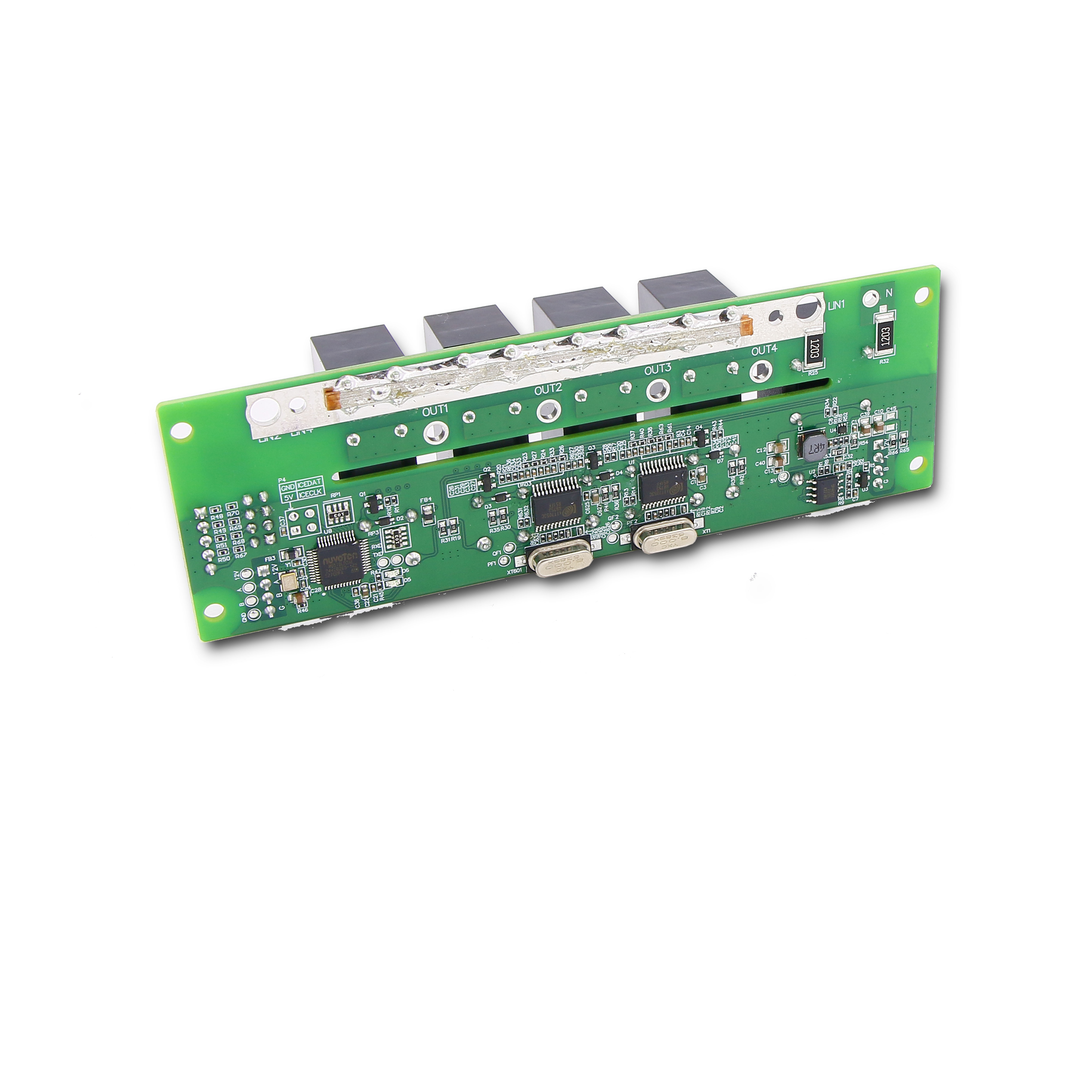
The Intelligent 2nd generation PDU product is a smart PDU rated for AC 110–250 V, 50/60 Hz input with a maximum load current of 0–63 A, and it accepts either single-phase or three-phase input. It is the only configuration in this shortlist that combines measured input, measured output and independent switching on the same device.
Inclusion reason 1 — measurement covers four quantities on both sides. On the input side the device collects current, voltage, electrical energy and power, where power is broken down into active power, reactive power, apparent power and power factor. The same four quantities are collected on the output side. For a compute rack, that is what turns electricity cost from an estimate into an allocated figure per rack and per channel.
Inclusion reason 2 — accuracy is stated in ranges, not as a single headline number. Input voltage accuracy is 0.5% over 85–250 V. Input current accuracy is level 1 in the 0.65–3.1 A band and level 0.5 in the 3.1–63 A band. Output voltage accuracy is 1% over 85–250 V, and output current monitoring spans 0.2–16 A with 2% accuracy from 0.2–0.8 A and 1% from 0.8–16 A. A buyer can therefore test whether the accuracy declaration matches the load band the rack will actually run in — a criterion that a single "high accuracy" claim cannot support.
Inclusion reason 3 — output topology is modular. The auxiliary module provides four outputs, and the main module supports up to eight auxiliary modules. Rated output voltage is AC 220 V, 50/60 Hz, with a maximum of 16 A per channel and 32 A per board. The output function is separate monitoring and control, meaning a channel can be watched and switched without affecting the others.
Where it fits and where it does not. The manufacturer lists data center and cloud computing, telecommunications, financial, government and public utilities, industrial automation and manufacturing, transportation and energy, and medical applications as its intended industries. It suits a compute rack whose operator needs per-channel visibility and remote switching. It is not the right first choice for a cabinet that only needs a metered feed, and it should not be assumed to provide a specific network protocol purely because it is a smart PDU — protocol support belongs in the RFQ as a model-level confirmation.
Configuration 2 — 1U_1.5U 485 PDU: network, edge and metered distribution points

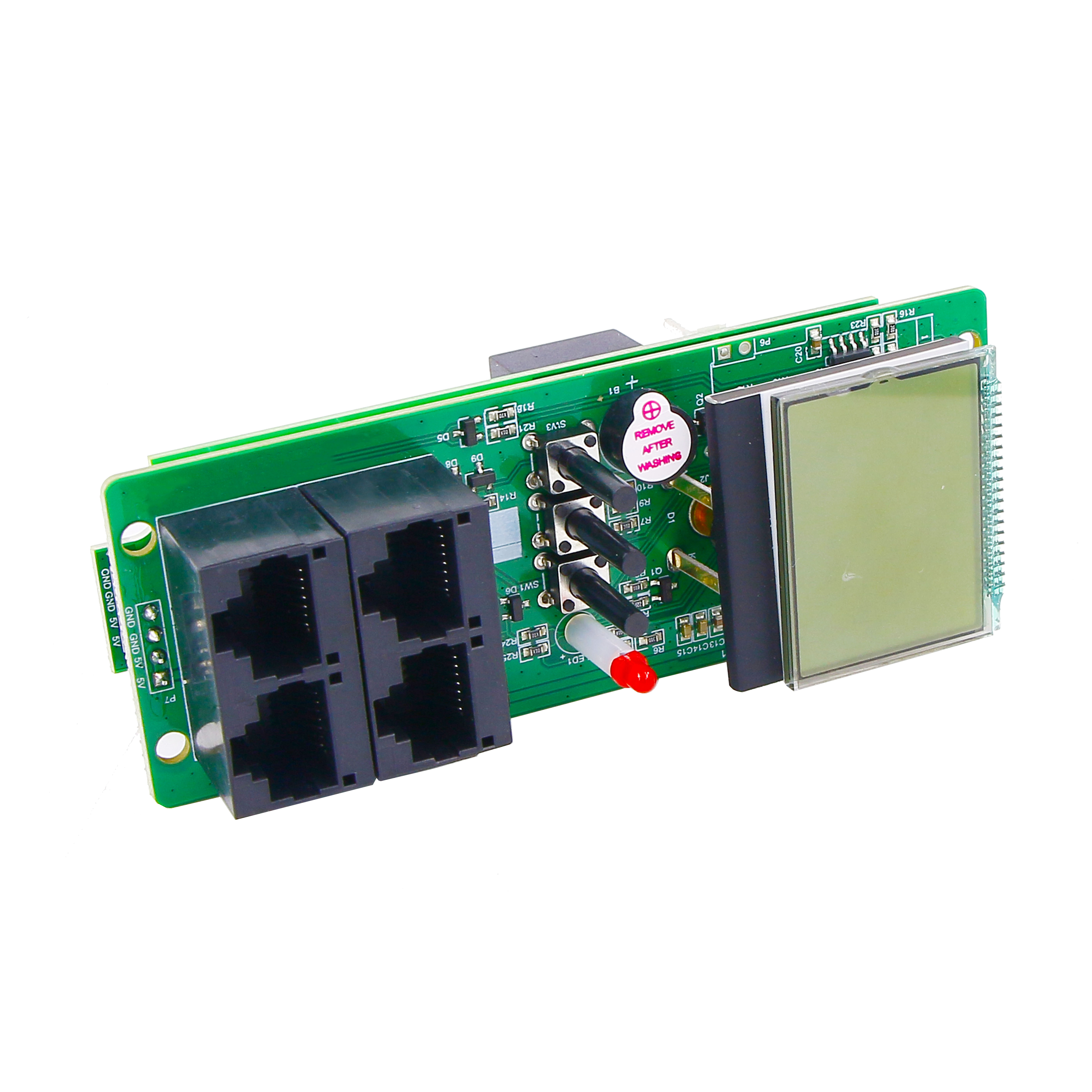
The 1U_1.5U 485 PDU is an RS485 metering PDU in a 1U or 1.5U rack form factor, rated for 100–240 V input with an operating input voltage range of 90–264 V. It is the configuration that answers the fieldbus requirement directly rather than by assumption.
Inclusion reason 1 — RS485 with Modbus is stated at product level. The device provides an RS485 interface using the Modbus communication protocol. Where the site already runs an RS485 bus for power or environmental monitoring, this configuration joins that bus without adding a separate network layer, and it pairs naturally with the water leak detector described in Configuration 3, which also communicates over RS-485 with Modbus.
Inclusion reason 2 — the form factor protects scarce rack space. At 1U or 1.5U, the unit fits in a shallow network cabinet or in the last remaining units of a shared rack, which is often the binding constraint in a small room. Current measurement is taken through an external transformer, so the metering point is defined by the installed transformer rather than by an integrated sensor.
Inclusion reason 3 — accuracy and readability are specified in usable terms. Voltage, current, power and energy measurement are each class 1 (1% ± 0.1), with displayed resolution of 0.01 V, 0.01 A, 0.01 kW and 0.01 kWh respectively. Overvoltage, undervoltage and overcurrent alarms are provided, and the alarm parameters can be set. The segment code LCD with white background and black text is readable at the rack without a laptop or a management session.
Where it fits and where it does not. Its intended industries mirror the smart PDU range — data centers and cloud computing, telecom, finance, government, industrial automation, transportation and energy, and medical. It is the right choice for a network rack, an edge cabinet or a distribution point that must be metered and read over RS485. It is not a substitute for Configuration 1 where per-channel remote switching is required; that function is stated for the Intelligent 2nd generation PDU, not for this model.
Configuration 3 — Sensor add-ons: room-level environment and physical security
Power data alone does not describe a small data center. The third configuration adds the environmental and physical signals that explain why a rack behaved the way it did — a temperature excursion, a door left open, water on the floor, or smoke.
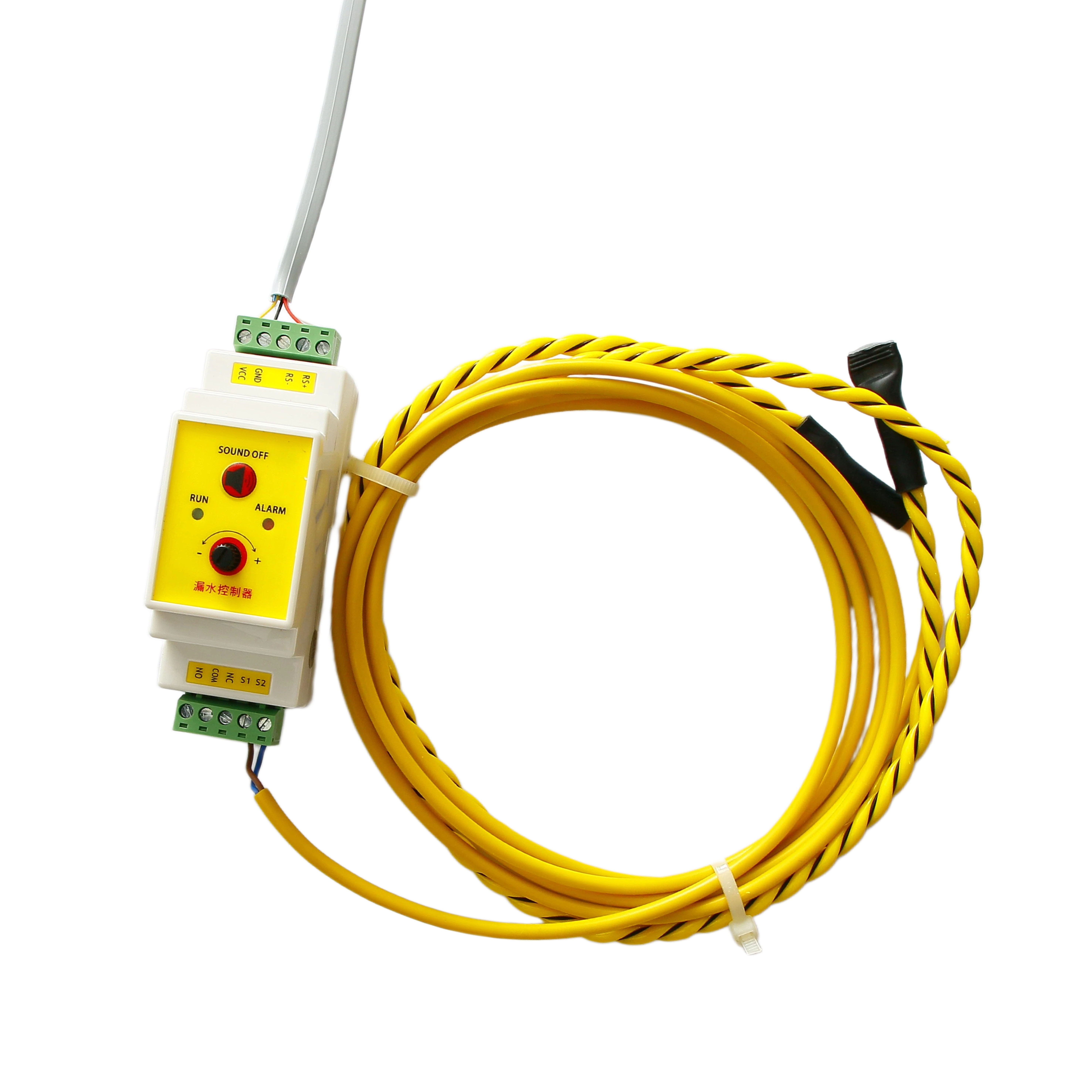
Inclusion reason 1 — the leak controller speaks the same bus as Configuration 2. The BM-CGQ06 water leak detector is a controller with a 12 V DC, 3 W supply, an SPDT relay output (normally open or normally closed), an RS-485 interface using Modbus, a maximum sensor cable length of 500 m, and an RS-485 communication range of up to 1200 m without a repeater. It mounts on a 35 mm DIN rail and carries RoHS and industrial-grade certification statements. Because both the leak controller and the RS485 PDU use RS485 Modbus, one bus can carry both power and leak data.
Inclusion reason 2 — temperature and humidity accuracy is quantified. The BM-CGQ02 digital temperature and humidity sensor uses an I²C interface at 2.2–5.5 V DC, with humidity accuracy of ±2% RH typical over 0–100% RH and temperature accuracy of ±0.3°C typical over −40°C to 80°C. The BM-CGQ04 offers a comparable alternative at ±3% RH and ±0.5°C typical at 25°C and 3.3 V, factory calibrated. The two options let a buyer match sensor grade to the decision being made rather than to a catalogue tier.
Inclusion reason 3 — smoke and door signals use simple, integrable outputs. The BM-CGQ05 smoke detector is a wired photoelectric unit powered at 10–35 V DC with an LED alarm indicator, alarm signal output, and 2-wire or 4-wire configuration, mounted on a wall or ceiling base. The BM-CGQ07 door sensor is a dry contact device with configurable normally open or normally closed output, 5–30 V DC operating voltage, 100 mA maximum switching current, an actuation gap of ≤15 mm, IP40 protection and an operating range of −10°C to +55°C.
Where it fits and where it does not. These devices monitor; they do not distribute or switch rack power. They are specified as a supplement to Configuration 1 or 2, and their value depends on a defined mounting position, cable route and bus address plan.
Step-by-Step Breakdown: How to Apply the Shortlist
The shortlist only becomes useful when it is applied in a fixed order. The sequence below follows the way a small data center is normally planned — rack by rack, then bus by bus, then document by document.
Step 1 — Map racks to roles. Label every rack as compute, network, storage, edge or mixed. A rack that carries both servers and switches should be treated as compute for the purpose of this shortlist, because it inherits the higher monitoring requirement.
Step 2 — Record the electrical facts of each rack. Note the supply type (single-phase or three-phase), the maximum current, and the connector type. Configuration 1 accepts single-phase or three-phase input up to 63 A; Configuration 2 is rated 100–240 V with a 90–264 V operating range. Comparing the rack feed against these figures is the first filter.
Step 3 — Decide whether per-channel control is needed. If the operating model includes remote reboots, staged load switching or per-channel energy allocation, the rack needs Configuration 1, where output monitoring and control are separate per channel. If the rack only needs a metered feed with local reading and alarms, Configuration 2 is sufficient.
Step 4 — Confirm the communication path at model level. Configuration 2 states RS485 with Modbus, and the BM-CGQ06 leak controller states RS-485 with Modbus. Any other protocol — including IP-based management, IPv6, or cascading — must be confirmed in writing for the exact model. Public manufacturer documentation illustrates why this matters: Raritan states that its intelligent rack PDUs support IPv4 and IPv6 management networking, and separately states PDU-to-PDU cascading up to 16 devices, while Vertiv documents daisy-chaining up to 50 devices on a single IP address through its Intelligence Director architecture. Those two device counts describe different architectures and are not directly comparable, so a specification should name the topology, the maximum downstream units and the IP-address behaviour rather than a bare device count.
Step 5 — Confirm physical fit and mounting. Check spare U height for a 1U or 1.5U device on network racks, and reserve DIN rail space for the leak controller. The door sensor and smoke detector need ceiling or wall positions that are reachable and outside the airflow path of the cooling system.
Step 6 — Assemble the compliance file. BOMPDU's production facility operates in compliance with ISO 9000 (Quality Management System) and ISO 14000 (Environmental Management System) standards, and the company holds more than ten invention patents covering PDU connector types. Ask for the applicable IEC 62368-1:2023 conformity position for each quoted model, plus any RoHS or industrial-grade statements that apply to the accessories. Certification should be attached to a model number, never to a brand name alone.
Step 7 — Validate with a small quantity. BOMPDU supports OEM/ODM production with a minimum order quantity of 2 units, 100% testing and a stated lead time of 30 days, with monthly capacity of 1000 units. That combination allows a pilot rack to be equipped and observed before the rest of the room is committed.
Use Cases: Where These Configurations Have Been Deployed
Two reference deployments illustrate how the configurations are typically combined. Both are BOMPDU installations of the Intelligent 2nd generation PDU product.
Airport data center, China — 800 units, three years in service. The stated application is electricity usage monitoring, and the reported capability is real-time monitoring of current, voltage, energy and power for each socket. The reported result is three years of stable operation. For a small data center, the relevant lesson is that per-socket data was the requirement that justified the higher configuration — not the device count.
Data center server manufacturer, China — 2000 units, two years in service. The application is server aging testing, with remote control of on and off states and real-time monitoring, allowing unmanned on-site operation. The reported result is two years of stable operation. This is the clearest illustration of why Configuration 1 exists on a compute rack: the ability to switch a channel remotely is what makes an unattended test cycle possible.
Other applications documented for the same product family include telecom base station support, where the function is remote reboot with voltage and current monitoring under wide temperature and lightning protection requirements; government emergency command centers, where the function is hierarchical power management with fault alarms under a dual power input requirement; and intelligent traffic systems, where centralized power control and status feedback are required under surge protection and rail-mount installation conditions.

Configuration Comparison Table
| Selection criterion | Intelligent 2nd generation PDU product | 1U_1.5U 485 PDU | Sensor add-ons (BM-CGQ02/04/05/06/07) |
|---|---|---|---|
| Primary rack role | Compute, cloud and mixed server racks | Network, edge and metered distribution points | Room-level environment and physical security |
| Electrical rating | AC 110–250 V, 50/60 Hz; max load 0–63 A; single-phase or three-phase input | Rated 100–240 V; operating range 90–264 V | Sensors: 2.2–5.5 V DC (temp/humidity); 10–35 V DC (smoke); 5–30 V DC (door); 12 V DC, 3 W (leak controller) |
| Measurement scope | Input and output current, voltage, energy, and active/reactive/apparent power plus power factor | Voltage, current, power and energy, class 1 (1% ± 0.1) | Temperature ±0.3°C typical / ±0.5°C typical; humidity ±2% RH / ±3% RH typical |
| Control capability | Separate monitoring and control per output; 16 A per channel, 32 A per board | Not stated as a switching function; alarm parameters are settable | Relay output (SPDT) on the leak controller; alarm signal output on the smoke detector |
| Communication | Confirm protocol per model in the RFQ | RS485 interface, Modbus protocol | RS-485 with Modbus (BM-CGQ06); I²C (BM-CGQ02/04); dry contact or alarm output (BM-CGQ07/05) |
| Form factor and mounting | Metal, plastic and aluminium profile construction; auxiliary modules with four outputs each, up to eight modules per main module | 1U / 1.5U rack format; segment code LCD, white background with black text | 35 mm DIN rail (leak controller); wall or ceiling base (smoke); surface or screw mount, IP40 (door) |
| Compliance evidence to request | ISO 9000 and ISO 14000 system compliance; IEC 62368-1:2023 conformity position for the quoted model | Same system compliance; model-level standards declaration | RoHS and industrial-grade statement (BM-CGQ06); industrial-grade application standard (BM-CGQ05) |
Figures in this table are taken from BOMPDU product specifications and company information. Values are stated per model or per family as published and are not interchangeable between rows.
Frequently Asked Questions
Which compliance documents should a small data center request before approving a smart PDU?
Request the quality and environmental management position, a model-level safety standards declaration, and any accessory-specific statements. BOMPDU's production facility operates in compliance with ISO 9000 (Quality Management System) and ISO 14000 (Environmental Management System) standards. Because IEC 62368-1:2023 is the mandatory safety standard for ICT and AV equipment including PDUs in most major jurisdictions, the quotation should state how the exact model being supplied addresses that standard. Accessories carry their own statements: the BM-CGQ06 water leak controller is listed with RoHS and industrial-grade certification, and the BM-CGQ05 smoke detector is listed against an industrial-grade application standard. A brand-level certificate is not sufficient on its own; the document should reference the model number.
How should RS485 Modbus PDUs and monitored smart PDUs be divided across rack roles?
Divide by function, not by price tier. The 1U_1.5U 485 PDU provides an RS485 interface with Modbus and class 1 measurement of voltage, current, power and energy, with settable overvoltage, undervoltage and overcurrent alarms — enough for network racks, edge cabinets and distribution points that must be metered and read over an existing bus. The Intelligent 2nd generation PDU product adds separate monitoring and control on each output channel, with up to eight auxiliary modules of four outputs each, a maximum of 16 A per channel and 32 A per board. That per-channel control is what compute racks need for remote switching and per-channel energy allocation. A useful rule: if the rack must be switched, specify the Intelligent 2nd generation PDU; if it must be measured and read over RS485, specify the 1U_1.5U 485 PDU.
If the budget only covers one upgrade this year, which rack should be equipped first?
Equip the rack where a single failure or an unallocated cost has the greatest operational consequence. In most small data centers that is the compute rack carrying production servers, because it needs both per-channel measurement for energy allocation and per-channel switching for recovery without a site visit — the combination delivered by the Intelligent 2nd generation PDU product. Network racks can follow with the 1U_1.5U 485 PDU, which delivers metering and alarms at the lower end of the metering requirement. Sequencing matters more than volume: BOMPDU's minimum order quantity is 2 units, so a phased rollout is practical, and the environmental sensors can be added once the mounting positions and the RS485 addressing plan are fixed.
Can a buyer validate the configuration with a sample before committing to a full room?
Yes. BOMPDU supports OEM/ODM production with a minimum order quantity of 2 units and 100% testing of production. A pilot can therefore cover one compute rack and one network rack, which is enough to verify the two things that sample testing is meant to establish: that the metering values on the 1U_1.5U 485 PDU match the readings of a reference meter connected through the external transformer, and that the per-channel control on the Intelligent 2nd generation PDU product behaves as expected for the loads actually installed. Documented reference deployments include an airport data center running 800 units for three years and a server manufacturer running 2000 units for two years in aging-test applications.
What lead time and customization limits apply to these configurations?
BOMPDU states a lead time of 30 days, a minimum order quantity of 2 units, monthly capacity of 1000 units, 100% testing, and remote after-sales support. Customization is offered under an OEM/ODM model covering metering and control configuration, outlet number, and single-phase or three-phase input. Because the output topology of the Intelligent 2nd generation PDU product is modular — four outputs per auxiliary module, up to eight auxiliary modules — outlet count and channel layout should be fixed in writing before production, together with the protocol requirements for the exact model. To review the full range before specifying, the BOMPDU product catalogue can be downloaded here: BOMPDU product catalogue (PDF). Buyers who want a configuration reviewed against a specific rack list can send the rack schedule and load figures to the BOMPDU team at tony1091803@wxbom.cn or request a sample and quotation through www.wuxibom.com.
Conclusion
A small data center rarely needs more than three PDU configurations, but it does need the right three. The Intelligent 2nd generation PDU product earns its place on compute and cloud racks because it measures input and output across current, voltage, energy and power, states its accuracy by load band, and monitors and controls each output channel separately. The 1U_1.5U 485 PDU earns its place on network, edge and metered distribution points because it provides RS485 Modbus communication, class 1 measurement and settable alarms in a 1U or 1.5U form factor. The sensor add-ons earn their place because they explain the electrical data — temperature and humidity at ±0.3°C typical, water leak over the same RS-485 Modbus bus, smoke and door status through standard signal outputs.
The selection discipline is what makes the shortlist work: state the rack role, state the electrical facts, state whether switching is required, confirm every protocol at model level, and attach certification evidence to the model number rather than to the brand. Applied in that order, three configurations cover a small data center without over-specifying the racks that only need metering.
Wuxi Bom Electronic Technology Co., Ltd. (BOMPDU) — founded 2018, Wuxi, Jiangsu, China. Contact: tony1091803@wxbom.cn | +86 18751550927 | WhatsApp +1 (786) 989-2761.