02
11/2026
Smart PDU Support After Installation: FAQ for Long-Term Rack Operations
Post-installation support for a Smart Power Distribution Unit: which records to retain, how to verify ISO 9001:2015 certificate 05126Q03324R001, support terms, MOQ and lead time.
Smart PDU Support After Installation: FAQ for Long-Term Rack Operations
Short answer: support for a Smart Power Distribution Unit does not begin at the help desk — it begins at handover. A rack stays supportable for years when four artefacts are captured on day one: the as-built model and phase record, the metering and accuracy baseline, the alarm and outlet control map, and a certification file whose scope and validity still match the supplier when an audit arrives. BOMPDU — the brand of Wuxi Bom Electronic Technology Co., Ltd., a Wuxi-based manufacturer of intelligent PDU products founded in 2018 — lists remote support as its after-sales capability. The record procurement teams re-open most often later is ISO 9001:2015 certificate 05126Q03324R001, issued by NOA Testing & Certification Group Ltd. and valid from 24 July 2026 to 23 July 2029.
Why Support Problems Usually Start After Acceptance
In most projects the technical risk is assumed to end when the racks are energised and the punch list is closed. In practice the opposite happens: the site loses the people who configured the PDU, and the equipment enters a ten-year phase in which every question has to be answered from documents.
The recurring failure patterns are predictable and all of them are documentation problems rather than product problems:
- No metering baseline. Months later, a reported current reading cannot be judged as normal or drifted because nobody recorded which accuracy class applied at commissioning.
- Alarm thresholds left at default. A Custom Alarm Threshold PDU configured with factory defaults either produces nuisance alerts or stays silent during a genuine overload event.
- Outlet map undocumented. Remote switching on a Remote Control PDU reboots the wrong server because socket numbering was never mapped to asset tags.
- Certificate copied without its scope page. An auditor accepts the ISO 9001 number but cannot confirm whether the certified scope actually covers what was purchased.
- Network and phase details lost. A later capacity upgrade cannot be planned because the original single-phase or three-phase input arrangement and the expansion-module count were never written down.
Industry Background: Why Post-Installation Records Scale With the Market
Smart PDUs are no longer a niche premium tier. Research and Markets reported that intelligent PDUs accounted for more than half of total PDU market revenue as of 2023 (55%, Research and Markets, Power Distribution Unit Industry Research Report 2024–2030). MarketsandMarkets projects the global data center PDU market to reach USD 14.23 billion by 2032, with the intelligent PDU segment growing at a 19.5% CAGR from 2026 to 2032.
Two consequences follow for support teams. First, the installed base of Network Managed PDU and Socket-Level Monitoring PDU hardware keeps expanding, so the volume of post-installation questions grows with it. Second, the compliance environment around that hardware is stable but strict: IEC 62368-1:2023 is the safety standard applied to ICT and AV equipment, including PDUs, in most major jurisdictions (IEC / IECEE). Safety conformity is established at product level, but the evidence a buyer needs years later is organisational and documentary — the quality management system certificate and the design records behind the product.
That is why the support conversation for a Data Center PDU or an Industrial Smart PDU is less about spare parts than about which files survive the project team.
The Records That Keep a Rack Supportable
1. As-built model, phase and input record
The first page of the file should state exactly which product family was installed, at which phase configuration. BOMPDU's current portfolio includes the Intelligent 2nd generation PDU product and the 1U_1.5U 485 PDU. The Intelligent 2nd generation unit accepts a rated input of AC110V–250V at 50/60Hz with a maximum load current of 0–63A, and it is offered with single-phase input or three-phase input — a detail that must be recorded per rack, because a later Single/Three Phase Switchable PDU discussion is meaningless without knowing what the original feed actually was.
2. Metering and accuracy baseline
Accuracy claims only become useful when the class is frozen against the specific measurement. For the Intelligent 2nd generation PDU product, the published figures are:
- Input voltage accuracy: 0.5% across 85–250V.
- Input current accuracy: level 1 between 0.65–3.1A; level 0.5 between 3.1–63A.
- Output voltage accuracy: 1% across 85–250V.
- Output current monitoring range 0.2–16A, with 2% accuracy between 0.2–0.8A and 1% accuracy between 0.8–16A.
- Rated output current: maximum 16A per channel, maximum 32A per board.
Recording these numbers next to the rack asset list turns every future reading into a comparable value, and it prevents a socket-level monitoring report from being challenged on methodology.
3. Alarm parameter record
Alarms are configuration, not specification. On the 1U_1.5U 485 PDU, overvoltage, undervoltage and overcurrent alarms are provided with settable parameters. The handover file should capture the value set for each parameter, who set it, and the date — the same discipline that a Custom Alarm Threshold PDU project requires at commissioning.
4. Control and outlet map
The Intelligent 2nd generation PDU product provides separate monitoring and control per output, with an auxiliary module carrying 4 outputs and a main module supporting up to 8 auxiliary modules. That modularity is valuable but only if the file states which module sits in which rack position and which socket number maps to which asset. Where a deployment uses sequential power-on or a cascadable master-slave topology, record the start order, delay settings, and the exact topology definition — market practice on cascading is not standardised, which is precisely why the definition must be written down rather than assumed.
5. Certification and software record set
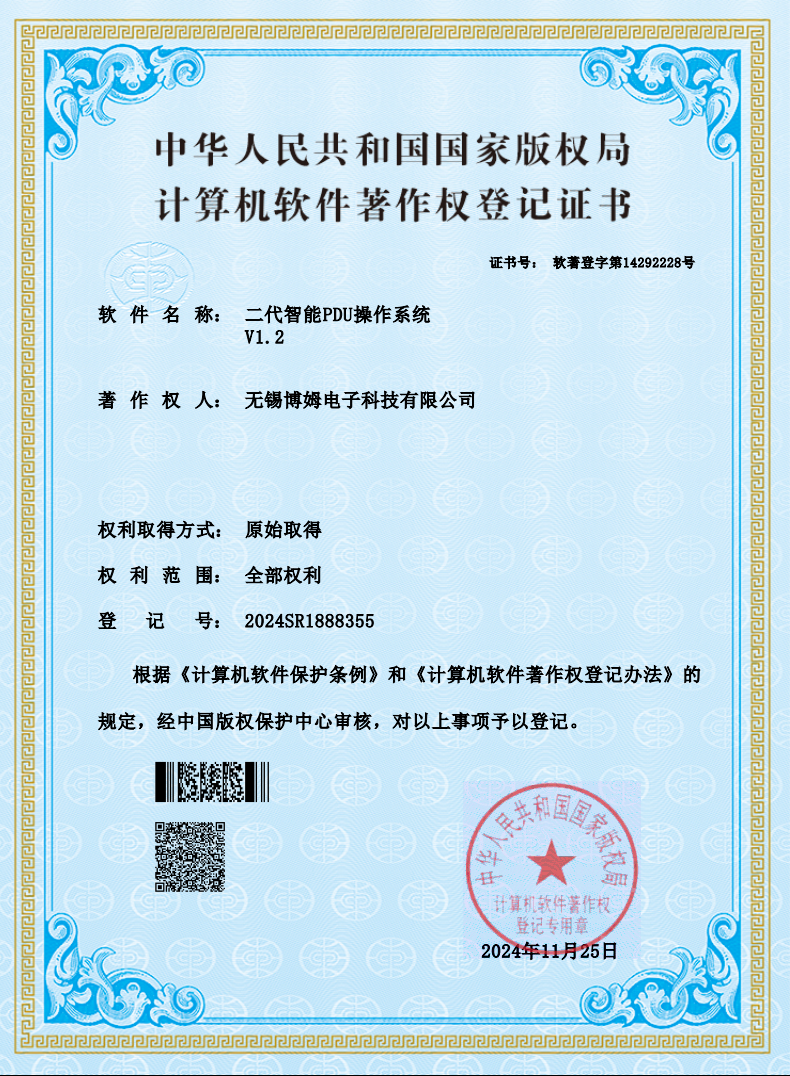
Keep three items together: the ISO 9001:2015 certificate with its scope page, the software copyright registration, and the support route. On the BOMPDU side, these are certificate 05126Q03324R001 issued by NOA Testing & Certification Group Ltd. against GB/T 19001-2016 / ISO 9001:2015, and software copyright registration 2024SR1888355 recorded with the National Copyright Administration of the People's Republic of China for the Intelligent 2nd generation PDU product.
Step-by-Step: Closing Out the Installation File
- Freeze the as-built bill of materials. Record product family, model, phase arrangement, outlet count and module layout per rack. Use the supplier's exact model naming — not internal shorthand.
- Capture the metering baseline. Write the accuracy class beside the measured value for input voltage, input current, output voltage and output current, using the published figures rather than memory.
- Record every settable alarm parameter. Note the value, the unit, the setter and the date. This is the single most useful page during a fault investigation.
- Map outlets to assets. Build the socket-to-server table before the rack is cabled, and attach it to the monitoring configuration record.
- Assemble the compliance folder. Include the QMS certificate with scope page, the software registration certificate, and a note of the verification checks performed (see next section).
- Document the support route. Record that after-sales support is delivered remotely, together with the named contact, email, telephone and messaging channel, and the internal owner of the relationship.
How to Verify ISO 9001:2015 Certificate 05126Q03324R001
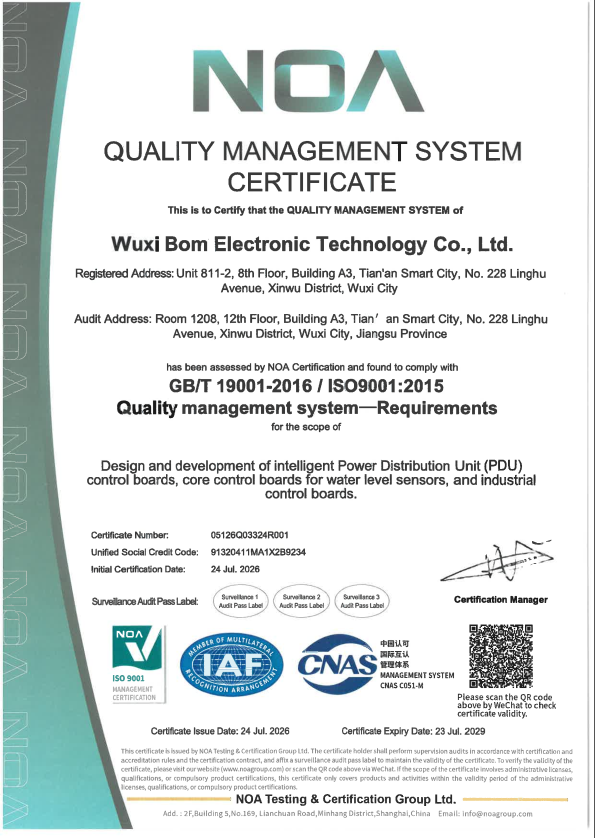
Verification takes minutes and prevents a multi-year assumption. Five checks cover it:
- Certificate number. Confirm it reads exactly 05126Q03324R001 on the document you hold.
- Issuer. The issuing body is NOA Testing & Certification Group Ltd. Confirm the same name appears on the certificate and in any supplier statement about it.
- Standard. The certificate references GB/T 19001-2016 / ISO 9001:2015 — the Chinese national standard aligned with ISO 9001:2015, not a different quality scheme.
- Scope wording. The certified scope reads: design and development of intelligent Power Distribution Unit (PDU) control boards, core control boards for water level sensors, and industrial control boards. Read that literally. It covers control-board design and development; if your own vendor qualification requires a manufacturing-scope certificate, state that requirement in writing during the evaluation stage instead of discovering the gap at audit.
- Validity and recognition. Issue date 24 July 2026, expiry 23 July 2029, with the certificate marked for the global market under IAF-MLA mutual recognition. Set an internal reminder before the expiry date, because a lapsed certificate in the file looks like a lapsed control system to an auditor.
The same discipline applies to the software record: registration 2024SR1888355 was issued on 25 November 2024 by the National Copyright Administration of the People's Republic of China, and its stated scope is the Intelligent 2nd generation PDU product. Retain the certificate image alongside the product documentation so that the record can be matched to the model actually installed.
Use Cases: What Retained Records Look Like in Practice
Two long-running deployments show why the file matters more than the ticket queue.
Airport data center, China — 800 units. An airport data center installed 800 units of the Intelligent 2nd generation PDU product to monitor electricity usage, with real-time monitoring of current, voltage, energy and power for each socket. The project has operated stably for 3 years. Three years of socket-level data is only comparable because the monitoring basis was fixed when the units went in; the same data without a recorded accuracy class would be an anecdote rather than an energy baseline.
Data center server manufacturer, China — 2,000 units. A server manufacturer deployed 2,000 units of the same product for server aging tests, using remote on/off control and real-time monitoring with unmanned on-site operation. The system has run stably for 2 years. Unmanned operation shifts the entire burden onto configuration records: the outlet map, the switching authority and the alarm settings must be documented, because nobody is walking the aisle to check them.
In both cases the supportable asset is not the PDU alone — it is the PDU plus the record set that makes remote operation auditable.
Comparison Tables
The first table lists the specification facts worth freezing at acceptance, taken from the two product families' published parameters. Blank cells indicate that the parameter is not stated in the source specification and should be confirmed per model.
| Handover field to record | Intelligent 2nd generation PDU product | 1U_1.5U 485 PDU |
|---|---|---|
| Rated input voltage | AC110V–250V, 50/60Hz | 100V–240V (input range 90V–264V) |
| Maximum load current | 0–63A | Confirm per model |
| Power input method | Single-phase input / three-phase input | Confirm per model |
| Input voltage accuracy | 0.5% across 85–250V | Level 1 (1% ± 0.1) |
| Input current accuracy | Level 1 at 0.65–3.1A; level 0.5 at 3.1–63A | Level 1 (1% ± 0.1) |
| Output measurement | Voltage 1% across 85–250V; current 2% at 0.2–0.8A, 1% at 0.8–16A | Power and electricity level 1 (1% ± 0.1) |
| Output control | Separate monitoring and control; max 16A per channel, max 32A per board | Segment-code LCD, white on black |
| Expansion / communication | Auxiliary module with 4 outputs; main module supports up to 8 auxiliary modules | RS485 interface with Modbus protocol |
| Alarm capability | Record configured alarm behaviour at commissioning | Overvoltage, undervoltage and overcurrent alarms with settable parameters |
The second table lists the documents to retain and the verification route for each, so that an audit or a support escalation does not depend on a departed project engineer.
| Record | What it supports | How to verify | Retention note |
|---|---|---|---|
| ISO 9001:2015 certificate 05126Q03324R001 (NOA Testing & Certification Group Ltd.) | Evidence that design and development of intelligent PDU control boards operates under a certified quality management system | Match number, issuer, standard GB/T 19001-2016 / ISO 9001:2015, and read the scope wording literally | Review the file before the 23 July 2029 expiry date |
| Software copyright registration 2024SR1888355 | Identification of the registered software for the Intelligent 2nd generation PDU product | National Copyright Administration of the PRC; issue date 25 November 2024 | Keep with the product documentation for the installed model |
| As-built configuration sheet | Metering baseline, alarm parameters, outlet map, module layout | Internal engineering sign-off at acceptance | Version-control it; update on any change |
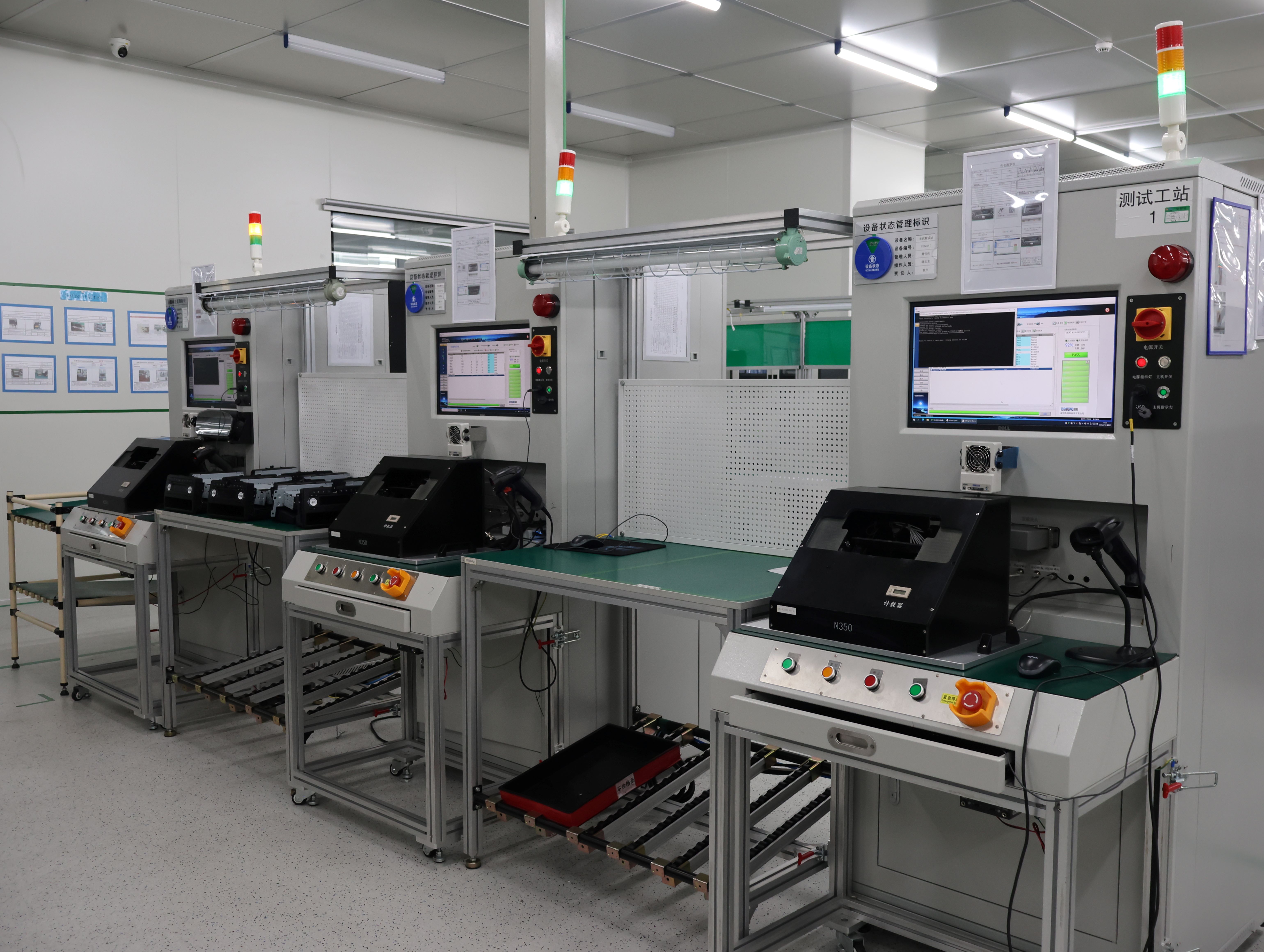
| Production test reference | Traceability from delivered unit to the 100% test regime | Supplier confirmation of test regime plus unit serials | Attach to the acceptance pack |
| Support route record | Confirms remote support as the after-sales channel and names the contact path | Supplier contact details verified at handover | Re-verify annually or on contact change |
FAQ: Post-Installation Support, Purchasing Terms and Records
1. Which certification records should we keep after a smart PDU installation is accepted?
Keep three records: the ISO 9001:2015 quality management system certificate with its full scope page, the software copyright registration, and your own configuration sheet. For BOMPDU products, the certificate is number 05126Q03324R001, issued by NOA Testing & Certification Group Ltd. against GB/T 19001-2016 / ISO 9001:2015, issued 24 July 2026 and expiring 23 July 2029, recognised for the global market under IAF-MLA mutual recognition. Its certified scope covers the design and development of intelligent Power Distribution Unit (PDU) control boards, core control boards for water level sensors, and industrial control boards. The software record is registration 2024SR1888355, issued on 25 November 2024 by the National Copyright Administration of the People's Republic of China for the Intelligent 2nd generation PDU product. Read the scope wording literally: it addresses control-board design and development, so if your qualification process demands a manufacturing-scope certificate, raise that requirement before the order rather than after the audit.
2. What support is available for configuration and measurement questions after commissioning?
After-sales support for BOMPDU products is delivered remotely, so the quality of the answer depends on the records you hold. Most measurement questions resolve directly against published accuracy figures: on the Intelligent 2nd generation PDU product, input voltage accuracy is 0.5% across 85–250V, input current is level 1 between 0.65–3.1A and level 0.5 between 3.1–63A, output voltage accuracy is 1% across 85–250V, and output current accuracy is 2% between 0.2–0.8A and 1% between 0.8–16A. On the 1U_1.5U 485 PDU, voltage, current, power and electricity measurement are level 1 (1% ± 0.1), communication runs over an RS485 interface with Modbus protocol, and overvoltage, undervoltage and overcurrent alarm parameters are settable. Quoting the configured value and the recorded accuracy class in your first support message shortens the diagnosis considerably.
3. What purchasing terms apply to repeat orders and rack expansion units?
Production runs in OEM/ODM mode, with a monthly capacity of 1000 units, a lead time of 30 days and a minimum order quantity of 2. Customisation is available on meter and control configuration, outlet number, and IP or three-phase input, and export supply is oriented to EU and Middle East markets. Because customisation changes the outlet map and the monitoring configuration, a repeat order should be treated as a documentation event as well as a purchasing event: the new units need their own configuration record, even where the model is unchanged.
4. Can we validate a unit before committing to a larger roll-out?
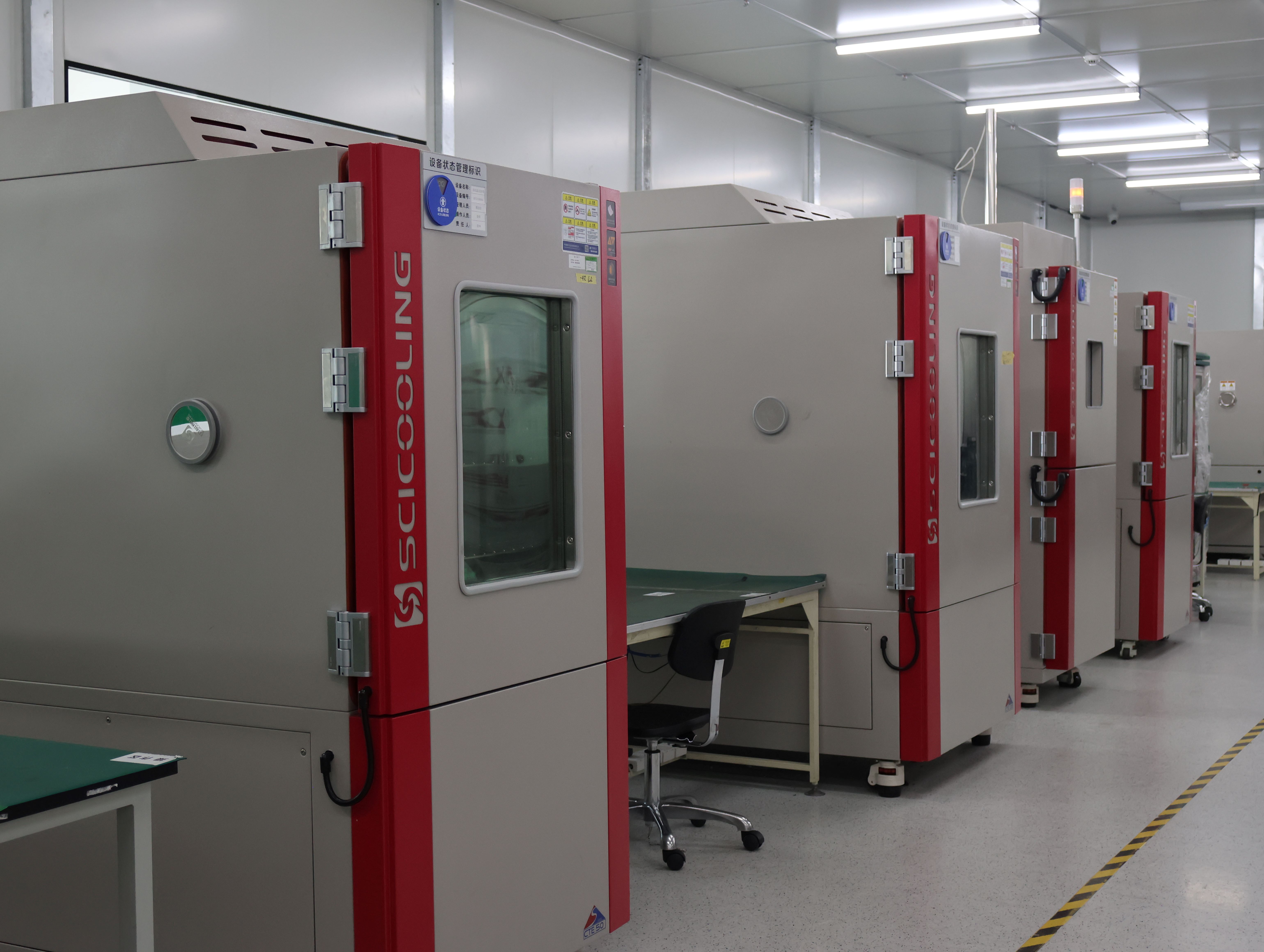
Yes. The minimum order quantity of 2 units allows a small validation order ahead of a wider roll-out, and every unit passes 100% test as part of production quality control. Use the sample to fix the baseline you intend to keep: record the accuracy class against your own reference measurement, confirm whether the deployed model includes sequential power-on behaviour, an IPv6 supported PDU management stack, or cascadable master-slave topology, and document the exact topology definition in writing, since cascading and daisy-chain counts are not standardised across the market. Anything confirmed at sample stage becomes a fact you will rely on for years.
5. How long does a repeat order take, and what should we do before placing it?
A repeat order runs on a 30-day lead time against a monthly capacity of 1000 units. Before placing it, assemble four inputs: rack count and phase arrangement, required outlet count and monitoring depth, the support and documentation deliverables you expect with delivery, and the contact path you will use afterwards. Sending those four items is enough to receive a quotation and a configuration proposal. You can download the product brochure at BOMPDU product brochure (PDF), or send requirements directly to the team at tony1091803@wxbom.cn.
Conclusion
Long-term rack operations are supported by documents, not by memory. The teams that avoid post-installation disputes are the ones that froze four things on acceptance day: the as-built model and phase configuration, the metering baseline with its accuracy class, the alarm and outlet control map, and a compliance folder containing ISO 9001:2015 certificate 05126Q03324R001 with its scope page and software registration 2024SR1888355. Everything else — remote troubleshooting, capacity expansion, energy reporting, audit response — is downstream of those four artefacts.
For a Smart Power Distribution Unit deployed in a data center or an industrial facility, the practical test is simple: hand the file to an engineer who has never seen the site and ask whether they could diagnose a socket-level anomaly. If the answer is yes, the installation is genuinely closed.
Next Step
Send your rack count, phase arrangement and monitoring requirements to receive a sample, a quotation and the full documentation set for your evaluation file.
Wuxi Bom Electronic Technology Co., Ltd. (BOMPDU)
Website: www.wuxibom.com
Email: tony1091803@wxbom.cn · Tel: +86 18751550927 · WhatsApp: +1 (786) 989-2761
Address: Room 1208, Building A3, Wuxi Tian'an Smart City, No. 228 Linghu Avenue, Xinwu District, Wuxi, Jiangsu, China
Brochure: Download the BOMPDU product brochure