
31
10/2026
How to Audit Smart PDU Supplier Delivery Assurance: A Step-by-Step Verification Checklist
A step-by-step checklist for auditing Smart PDU supplier delivery assurance: verify the ISO 9001:2015 certificate scope, map it to Smart PDU, RS485 PDU and sensor line items, and lock MOQ, acceptance criteria and lead time into dated milestones.
How to Audit Smart PDU Supplier Delivery Assurance: A Step-by-Step Verification Checklist
Test evidence, not a datasheet, is what converts a Smart PDU promise into a delivery schedule. Environmental and burn-in verification stages are the parts of a supplier audit that buyers can actually inspect.
Delivery assurance for a Smart Power Distribution Unit (Smart PDU) is auditable. It is not proven by a quotation, a feature list, or a certificate cover page, but by four document layers that can be checked in sequence: a certified quality management system whose scope you have actually read, a scope-to-BOM mapping for the exact models you are ordering, product-level test and protection evidence, and commercial terms converted into written milestones. This checklist walks through all four.
Why a Datasheet Cannot Prove On-Time Delivery
A delivery-assurance failure rarely begins in the factory. It begins in a document that was accepted without being read. Procurement teams comparing Smart PDUs usually receive the same packet: a product brochure, a price list, a quality certificate, and a lead-time sentence in an email. Three of those four items say nothing about whether the units will be packed and handed over on the agreed date.
The gap has a predictable shape. The certificate is issued against a quality management system, not against a shipment. The scope sentence on that certificate may describe design and development activities rather than finished-unit assembly. The quoted model may be a network-managed PDU with socket-level monitoring, while the certificate scope was written for a control board. And the lead time may be a typical figure rather than a committed date attached to an order quantity.
Industry Background: Why Delivery Assurance Became a Procurement Discipline
Smart PDUs are no longer a premium niche inside rack power distribution. ResearchAndMarkets reported that intelligent PDUs accounted for 55% of total PDU market revenue as of 2023 — more than half of the category. MarketsandMarkets projects the global data center PDU market to reach USD 14.23 billion by 2032, with the intelligent segment growing at a 19.5% CAGR across the 2026–2032 forecast period.
Growth of that shape has two consequences for buyers. First, more suppliers enter the category, and the distance between a competent manufacturer and a trading intermediary that resells the same catalogue widens. Second, schedule risk moves upstream: when demand accelerates, the suppliers who cannot demonstrate process control are the ones who slip.
A parallel compliance trend matters here. IEC 62368-1:2023 is the mandatory safety standard for ICT and AV equipment, including PDUs, in most major jurisdictions, per IECEE/IEC. That standard is a product safety requirement. ISO 9001:2015 is a quality management system requirement. They answer different questions, and a supplier audit that treats one as a substitute for the other leaves a hole in the file.
The Documentation-First Audit Model
The audit model below is built for procurement and engineering teams who are past the shortlist stage and need to convert a supplier claim into a delivery commitment. It runs in four layers, in this order, because each layer narrows the next.
Layer 1 — Verify the quality management certificate, then read the scope sentence
BOMPDU is the brand of Wuxi Bom Electronic Technology Co., Ltd., a manufacturer headquartered in Wuxi, Jiangsu Province, China, founded in 2018, focused on end-of-row power distribution solutions for data centers. Its quality management system is certified to ISO 9001:2015, with the applicable standard cited as GB/T 19001-2016/ISO9001:2015. The certificate is issued by NOA Testing & Certification Group Ltd. under certificate number 05126Q03324R001. The stated scope covers the design and development of Power Distribution Unit control boards, and the certificate applies to the global market.
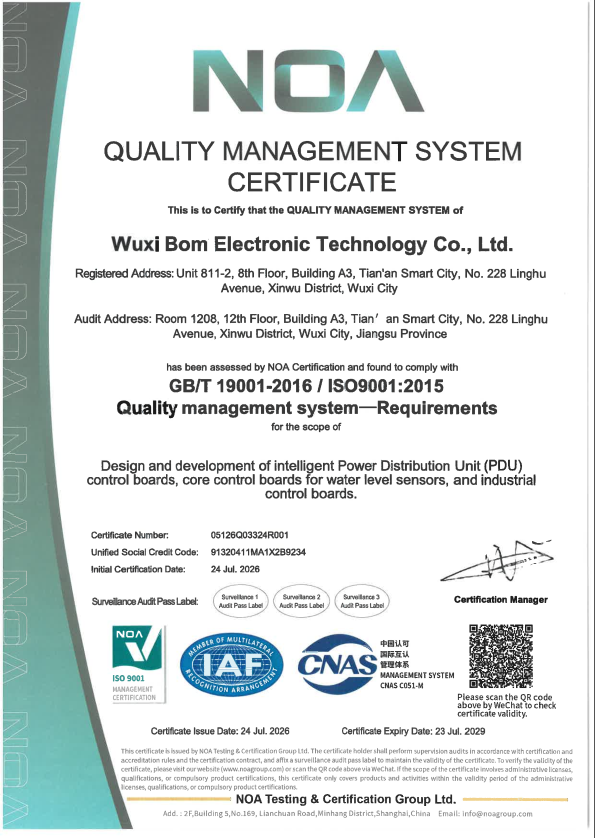
The certificate is the starting document of the audit, not the conclusion. The auditable detail is the scope wording and the certificate number.
Three verification actions belong at this layer. Confirm the issuer name and certificate number appear exactly as printed. Confirm the standard is written as ISO 9001:2015 rather than a generic quality claim. And read the scope sentence word by word, because the scope is the only part of the certificate that limits what the certification actually covers.
Layer 2 — Map the scope onto the exact product line being ordered
The second layer converts a company-level certificate into a purchase-order-level question. BOMPDU's product line covers two main families and a set of companion sensors: the Intelligent 2nd generation PDU, positioned for data center and cloud computing environments, the 1U_1.5U 485 PDU, and the BM-CGQ02, BM-CGQ04, BM-CGQ05, BM-CGQ06, and BM-CGQ07 sensors.
The mapping exercise is simple but rarely done. For each line item on the purchase order, write down what the certificate scope covers, what the supplier's test documentation covers, and what remains unaddressed. Control board design and development sits inside the certified scope. Sensor units, enclosure assembly, labelling, packing, and final acceptance testing sit outside it and must be covered by the acceptance criteria in the contract. When that split is written down, the buyer stops arguing about a certificate and starts specifying tests.
Layer 3 — Demand capability evidence at model level, not family level
Feature claims are where Smart PDU procurement most often loses precision. A supplier may offer network-managed PDUs, remote control PDUs, socket-level monitoring PDUs, sequential power-on PDUs, single/three-phase switchable PDUs, custom alarm threshold PDUs, and cascadable master-slave PDUs across a portfolio, while the model on your order carries only a subset. The audit must therefore ask for the model-level statement, plus the logic behind it.
Two documented control mechanisms are worth putting in the file as examples of the level of detail to require. For overload, the sub-control units use a dual-level alarm mechanism: the primary alarm triggers when current approaches the rated value, and the secondary alarm triggers on overload, with feedback delivered over RS485 or the network. For relay life, the sub-control unit relays are monitored and their control logs are recorded, so action status and service life can be tracked through log analysis rather than assumed.
Those two mechanisms are exactly the kind of evidence that separates a manufacturer from a reseller. A reseller can restate a feature list. It cannot produce relay action logs or explain the alarm threshold logic on a control board it did not design.
Layer 4 — Convert commercial terms into dated milestones
Delivery assurance becomes contractual here. BOMPDU's documented commercial parameters are specific enough to be audited: minimum order quantity of 2 units, typical production lead time of 30 days, and monthly production capacity of 1000 units, as stated in the delivery-assurance documentation applicable to the EU and Middle East markets. Production terms further include FOB delivery terms, pre-shipment test as the acceptance criterion, and 30/70 payment terms.
One nuance belongs in every audit file. Documented MOQ is configuration-dependent. The Intelligent 2nd generation PDU main module is documented at 70 units, the distributed control module at 100 units, and other configurations at 10 units, while the delivery-assurance statement cites 2 units. A buyer who accepts the lowest published number without confirming which configuration it applies to will discover the real figure at order confirmation. That is a schedule risk, and it is avoidable.
The Audit Checklist, Step by Step

Pre-shipment test is the acceptance criterion named in the commercial terms. The audit question is not whether the equipment exists, but which units pass through it and which records follow the shipment.
Use Cases: Where the Checklist Changes the Outcome
Data center build with IPv6 management requirements
A colocation operator specifying network-managed PDUs across a hall typically assumes IPv6 is available because the brand offers it. For reference, Raritan intelligent rack PDUs document IPv4 and IPv6 management networking, and Server Technology PRO4X units document SNMP, MODBUS, REST-based APIs, and Redfish integration. Those are useful benchmarks for what to require. The audit action is to make IPv6 an explicit, separately signed line in the technical RFQ rather than a family-level assumption, because a portfolio that supports IPv6 somewhere does not prove the ordered model does.
Industrial retrofit using RS485 PDU and sensors
A plant retrofit often runs on RS485 rather than IP, using the 1U_1.5U 485 PDU together with BM-CGQ02 through BM-CGQ07 sensors. Here the audit emphasis shifts from network protocol to protection logic and record keeping: dual-level overload alarms reported over RS485, and relay action logs that let maintenance plan replacements instead of reacting to failures. The scope-to-BOM table from Step 3 is what keeps sensor units from being treated as accessories that nobody tested.
Distributor stocking programme with committed delivery windows
A distributor committing to a regional stocking programme needs the numbers, not the narrative: which MOQ applies to each SKU configuration, the 30-day typical production lead time, and the 1000-unit monthly capacity ceiling. Because the delivery-assurance documentation is stated for the EU and Middle East markets, a distributor in another region should confirm applicability in writing before quoting delivery dates downstream.
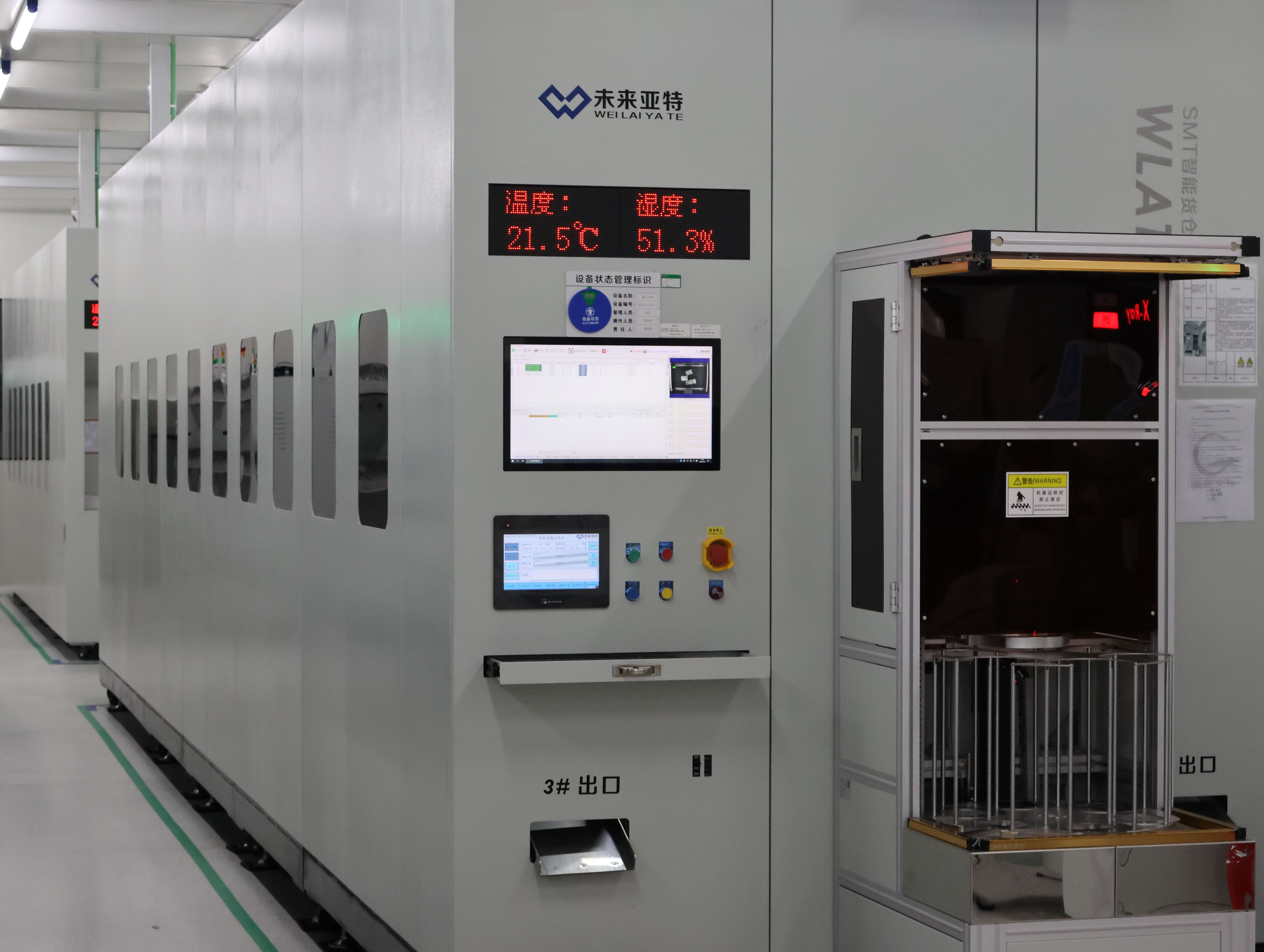
Capacity and warehousing discipline are what make a 30-day typical lead time credible at order quantity. Confirm both before committing delivery dates to your own customers.
Comparison: What the Same Audit Returns Across Suppliers
The table below uses only documented product and commercial facts available in the comparison data reviewed. Empty or unstated cells are shown as such rather than estimated, because an unstated specification is itself an audit result: it becomes a question in the RFQ.
| Audit dimension | SMART PDU (BOMPDU platform) | APC NetShelter Rack PDU Advanced | Raritan PX Rack PDU |
|---|---|---|---|
| Managed network link speed | 10/100 BASE-T | 10/100/1000 BASE-T | Not stated in the comparison data reviewed |
| High-density outlet module (HDOT-type) | Not supported | Not stated in the comparison data reviewed | Supported; HDOT groups outlets in modules to fit more outlets in a 42U PDU |
| Documented cost position relative to SMART PDU | Baseline | Stated 50% higher | Stated 50% higher |
| Outlet-level control and monitoring | Sub-control units with relay action logging and dual-level current alarm reported over RS485 or network | Not stated in the comparison data reviewed | Outlet-level switching and outlet-level power monitoring in relevant configurations |
| Audit action this cell triggers | Confirm link speed against the management network design; if 1 Gbps is mandatory, treat it as a qualification issue before ordering | Request current quotation before accepting the documented cost position | Confirm whether the ordered model is unit-level or outlet-level |
Two points about this table matter more than the cells. First, a documented difference is not automatically a disqualification; a 10/100 BASE-T management interface is adequate for supervision traffic in many deployments, and inadequate where the monitoring platform depends on gigabit links. Second, cost position must be re-confirmed per quotation — it is a commercial data point, not a permanent characteristic.
Cascading capacity deserves the same discipline. In the data reviewed, Raritan documents PDU-to-PDU cascading up to 16 devices, while Vertiv documents daisy-chaining up to 50 devices on a single IP address. Those figures use different architectures and counting methods, so they cannot be compared directly, and no combined range should be quoted. The correct audit output is a specification line: required topology, maximum downstream units, IP-address behaviour, and controller requirements.
FAQ
The applicable system standard is ISO 9001:2015, with the applicable standard cited as GB/T 19001-2016/ISO9001:2015. BOMPDU's certificate is issued by NOA Testing & Certification Group Ltd. under certificate number 05126Q03324R001, its scope covers the design and development of Power Distribution Unit control boards, and it applies to the global market. Buyers should read the scope sentence rather than the certificate cover, because a scope limited to control board design and development does not by itself certify final-unit assembly; that portion of quality assurance is evidenced by the pre-shipment test defined in the acceptance criteria. Note also that a quality management system certificate is not a product safety certification — IEC 62368-1:2023 is the mandatory safety standard for ICT and AV equipment including PDUs in most major jurisdictions, so product safety evidence should be requested separately.
Require a model-level statement plus the underlying control logic. Documented examples of that level of detail include a dual-level alarm mechanism for sub-control units — a primary alarm when current approaches the rated value and a secondary alarm on overload, with feedback over RS485 or the network — and relay status monitoring with recorded control logs, so relay action status and service life can be tracked through log analysis. Those statements should then be mapped onto the ordered items: the Intelligent 2nd generation PDU for data center and cloud computing environments, the 1U_1.5U 485 PDU, and the BM-CGQ02, BM-CGQ04, BM-CGQ05, BM-CGQ06, and BM-CGQ07 sensors.
The documented commercial framework is FOB delivery terms, pre-shipment test as the acceptance criterion, and 30/70 payment terms. Minimum order quantity is configuration-dependent: the delivery-assurance documentation states 2 units for the EU and Middle East markets, while the Intelligent 2nd generation PDU main module is documented at 70 units, the distributed control module at 100 units, and other configurations at 10 units. The audit action is to confirm in writing which MOQ applies to your specific BOM rather than assuming the lowest published figure applies.
A sample should prove the acceptance criteria, not just the appearance of the unit. Because pre-shipment test is the documented acceptance criterion, the sample stage should establish the pass and fail thresholds that the pre-shipment test will later apply: alarm threshold behaviour at approaching-rated and overload conditions, sequential power-on order where that function is ordered, and sensor readings where BM-CGQ-series sensors are part of the configuration. Where a sample includes sensor units, the sensor combination should be tested together with the PDU rather than separately. A sample that cannot be measured against a written criterion has not de-risked the production run.
The documented figures are a typical production lead time of 30 days, a monthly production capacity of 1000 units, and a minimum order quantity of 2 units for the configuration covered by the delivery-assurance statement applicable to the EU and Middle East markets. Those numbers should be converted into dated milestones rather than left as typical values: purchase order acknowledgement, production start, pre-shipment test date, test record handover, and FOB handover, each with a named owner. Buyers who want to move from evaluation to execution can request a sample or a configuration-specific quotation, and can review the published company catalogue for the full product range before finalising the BOM. Contact: tony1091803@wxbom.cn, www.wuxibom.com.
Conclusion: Assurance Is a File, Not a Promise
Delivery assurance for a Smart Power Distribution Unit is not established by a certificate hanging on a wall or a lead time typed into an email. It is established by a short, checkable file: the ISO 9001:2015 certificate with its scope read line by line, issued by NOA Testing & Certification Group Ltd. under number 05126Q03324R001 for the design and development of Power Distribution Unit control boards and applicable to the global market; a scope-to-BOM table covering the Intelligent 2nd generation PDU, the 1U_1.5U 485 PDU, and the BM-CGQ02 through BM-CGQ07 sensors; documented protection and relay logic at model level; and commercial terms — MOQ confirmed per configuration, FOB, pre-shipment test acceptance, 30/70 payment, 30-day typical lead time, and 1000 units monthly capacity — written as dated milestones.
Wuxi Bom Electronic Technology Co., Ltd., founded in 2018, operates with a 70-person team including 12 engineers, an annual output of 10,000 units, and more than ten invention patents covering common PDU connector types. Those facts are useful context, but they are not the audit. The audit is the eight steps above, performed once, filed, and re-checked against the next purchase order. Suppliers that can pass it will usually say so in writing within a day — and that response time is itself a data point about how they will handle a delivery problem later.
- Certificate standard, issuer, number, and scope verified as a document.
- Scope boundary written down and mapped to every ordered line item.
- Features converted into model-level, testable clauses.
- Acceptance criteria defined beyond the phrase pre-shipment test.
- MOQ confirmed for your configuration, not the lowest published value.
- Lead time and capacity converted into dated milestones with owners.

Production base of Wuxi Bom Electronic Technology Co., Ltd. in Wuxi, Jiangsu Province, where BOMPDU Smart PDU and RS485 PDU lines are built and pre-shipment tested.
Next Step: Put the Checklist Against a Real Configuration
Request a sample unit or a configuration-specific quotation, and ask for the audit documents referenced in this article — certificate, scope statement, model-level protection logic, and the dated milestone calendar — to be issued together with the offer. The full product range, including the Intelligent 2nd generation PDU, the 1U_1.5U 485 PDU, and the BM-CGQ02 to BM-CGQ07 sensors, is described in the downloadable catalogue.
Email: tony1091803@wxbom.cn | Website: www.wuxibom.com | Catalogue: Download the BOMPDU product catalogue (PDF)