21
11/2026
Smart PDU Supplier Evaluation: Certification Scope as Delivery Assurance
Use BOMPDU ISO 9001:2015 scope (certificate 05126Q03324R001) to test Smart PDU supplier delivery assurance, MOQ, testing and acceptance terms.
Smart PDU Supplier Evaluation: Certification Scope as Delivery Assurance
Supplier evaluation for a Smart Power Distribution Unit usually starts with a document request: quality certificate, datasheet, test report, references. The step that separates an evaluation from a document collection is matching what the certificate actually says to what the purchase order will require.
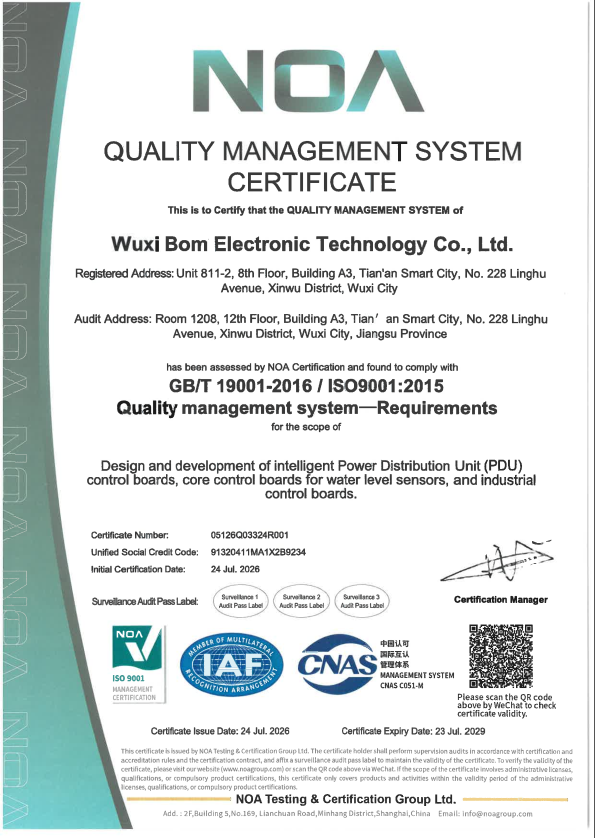
Wuxi Bom Electronic Technology Co., Ltd. (BOMPDU) holds quality management system certificate 05126Q03324R001, issued by NOA Testing & Certification Group Ltd. to GB/T 19001-2016/ISO 9001:2015, valid from 24 July 2026 to 23 July 2029. The recorded scope is the design and development of intelligent Power Distribution Unit (PDU) control boards, core control boards for water level sensors, and industrial control boards. The certificate is linked to product 1558 (Intelligent 2nd generation PDU product) and product 1559 (1U_1.5U 485 PDU).
Read correctly, that scope is evidence about the certified design-and-development process for the control board — the subsystem that carries metering, switching and alarm logic inside a smart PDU. It is not evidence that every commercial term, model-level rating or destination-market safety requirement has been met. This article converts the scope into delivery assurance: the commitments it supports, the terms it does not touch, and the acceptance criteria that make the certified process visible in what arrives at your dock.
The evaluation problem: a certificate answers a narrower question than buyers assume
An ISO 9001:2015 certificate is bounded by four things: the standard, the scope statement, the certified activity and the validity period. Under evaluation pressure these compress into a single yes-or-no answer — the supplier is certified — and the document then carries expectations it cannot support.
The result is a familiar mismatch. A buyer asks whether the supplier can hold a 30-day lead time across 1,000 units a month and receives a certificate copy. A buyer asks whether socket-level monitoring will behave the same in the fifth batch as in the approved sample and receives a sentence about control boards. Both questions are legitimate; neither is answered by the other's document.
Delivery assurance in a smart PDU purchase rests on four separable things: the design capability behind the control logic; the repeatability of production and testing; the commercial terms that allocate time and risk; and market-entry evidence for the destination country. A quality certificate with a design-and-development scope addresses the first, and supports the second only where the scope reaches the activities that determine product behaviour. The third and fourth have to be built into the purchase order.
That separation is what makes the evaluation usable at the Execution stage. Once a shortlist exists, the question is no longer whether a supplier is certified, but which of your delivery obligations the available evidence covers — and what you still need to add as a contractual requirement.
Industry background: why process evidence now separates suppliers
Smart functions are no longer the premium tier of the rack power market. ResearchAndMarkets' Power Distribution Unit Industry Research Report 2024–2030, published through BusinessWire on 11 November 2024, reports that intelligent PDUs accounted for more than 55% of total PDU market revenue as of 2023. MarketsandMarkets projects the data center PDU market reaching USD 14.23 billion by 2032 and states a 19.5% compound annual growth rate for the intelligent PDU segment across 2026–2032.
The buyer-side reading is straightforward: when metering, remote switching and network management are baseline expectations rather than differentiators, suppliers converge on feature lists and diverge on process evidence — who designs the control board, how production is tested, and what can be committed in writing.
The regulatory layer is separate and should not be blended into that discussion. IEC 62368-1:2023 is the safety standard for ICT and AV equipment, listed in the reviewed evidence set as the applicable safety standard in most major jurisdictions (IECEE/IEC). A quality management certificate and a product safety standard address different risks; evidence for one does not discharge the other.
The certificate fields that carry evidence, and what each one supports
The certificate is a short document. Its evaluation value comes from treating each field as a separate evidence claim rather than as one compliance badge.
| Certificate field | Recorded value | Use in the supplier evaluation |
|---|---|---|
| Certificate number | 05126Q03324R001 | Uniquely identifies the document; quote it in the supplier file so the same certificate can be re-verified at each audit or renewal. |
| Issuing body | NOA Testing & Certification Group Ltd. | Identifies who can confirm status; verification should reach the issuer, not only the supplier's copy. |
| Standard | GB/T 19001-2016/ISO 9001:2015 | Confirms a quality management system standard. It is not a product safety, performance or EMC standard. |
| Scope | Design and development of intelligent PDU control boards, core control boards for water level sensors, and industrial control boards | Evidence of a certified design-and-development process for the control board — the subsystem carrying monitoring, switching and alarm logic. |
| Related products | 1558 Intelligent 2nd generation PDU product; 1559 1U_1.5U 485 PDU | Ties the certificate to named products; check that the copy you receive names the model you are buying. |
| Validity | Issued 24 July 2026; expires 23 July 2029 | Confirms current status at the order date; set a re-check trigger before expiry. |
| Market applicability | Global (IAF-MLA mutual recognition) | Supports cross-market acceptance of the certificate; does not replace destination-market product approval. |
IAF-MLA mutual recognition means the issuing body's accreditation sits within the International Accreditation Forum's multilateral recognition arrangement, so the certificate is intended to be accepted across participating economies without a separate national re-certification of the management system. That is a real procurement convenience when a project spans several regions and the supplier file has to be approved by more than one team.
It does not convert a management system certificate into a product-level approval. Safety marks, EMC evidence and market-specific registration for the finished PDU remain separate lines on the RFQ, and the evaluation should show them as separate lines.
What the scope covers, and what it leaves to your purchase order
Stated positively, the certificate covers three activities: design and development of intelligent PDU control boards, design and development of core control boards for water level sensors, and design and development of industrial control boards, with products 1558 and 1559 named as related products.
Stated by exclusion — the more useful direction in a supplier evaluation — the scope statement does not settle:
- Model-level electrical ratings for the PDU you intend to buy;
- Assembly, wiring and enclosure workmanship standards for the finished unit;
- Commercial terms such as MOQ, Incoterm and payment split;
- Destination-market product safety or EMC approval;
- Per-shipment test evidence, unless the purchase order asks for it;
- Packaging and logistics performance.
For an evaluation, the practical reading is that the certificate answers the capability question that matters most in a smart PDU: whether the organisation designing the board that performs metering, switching and alarm handling operates a certified design-and-development process. It says nothing about whether a specific custom alarm threshold, sequential power-on sequence, IPv6 management stack or master-slave cascade behaviour has been implemented and verified on your model. Those are model-level questions that need model-level answers.
Matching the certificate to products 1558 and 1559
Product 1558, the Intelligent 2nd generation PDU product, is the platform behind both company-reported installations described later in this article, and it carries a second document trail of its own: computer software copyright registration 2024SR1888355, issued by the National Copyright Administration of the People's Republic of China on 25 November 2024, with a stated scope covering the Intelligent 2nd generation PDU product and a China market. When firmware is part of what you are buying, that registration adds a separate, checkable reference for the product's software identity. It is a China registration, so it should not be presented as a global intellectual-property position.
Product 1559, the 1U_1.5U 485 PDU, is listed as a related product on the same quality certificate. The model designation records the 1U/1.5U rack format and a 485 interface. If rack fit or interface behaviour is a pass-or-fail criterion in your evaluation, confirm both at model level against your cabinet drawing and your management platform, rather than inferring them from the model name.
One check catches a recurring failure: does the certificate copy in your file name the product you are actually buying? Certificates that list related products get circulated with the wrong model highlighted, and an evaluation built on the wrong line item is worse than no evaluation, because it looks complete.
Step-by-step: converting certification scope into delivery assurance
Step 1 — Verify the document, not just the claim
Match three items against the issuer before anything else: certificate number 05126Q03324R001, standard GB/T 19001-2016/ISO 9001:2015, and issuing body NOA Testing & Certification Group Ltd. Then note the validity window — issued 24 July 2026, expiring 23 July 2029 — and place a re-check date in the supplier file before renewal. A genuine certificate whose number does not match the issuer's register ends the evaluation faster than any technical question.
Step 2 — Read the scope sentence clause by clause
The recorded scope lists three board categories: intelligent PDU control boards, core control boards for water level sensors, and industrial control boards. Only the first is directly relevant to a PDU purchase; the other two show the design team also works on adjacent control-board families, which is context rather than proof. If your requirement set moves beyond PDU control boards, do not assume the scope travels with it.
Step 3 — Map the certified activity to the failure modes that carry cost
Inside a Smart Power Distribution Unit, the expensive failures sit in the control layer: a metering channel that drifts, a relay that fails to switch back, an alarm that never fires, a controller that drops off the management network. A certified design-and-development process for the control board is the closest evidence available at certificate level that those functions are engineered under control. It is still not a test result, so pair it with model-level documents: specifications, test records and firmware identity for the exact product.
Step 4 — Keep quality evidence and safety evidence in separate columns
ISO 9001:2015 addresses process capability. IEC 62368-1:2023, the safety standard for ICT and AV equipment cited in the reviewed evidence set as applicable in most major jurisdictions, addresses product safety. Ask for the product-level safety file for the destination market as its own line item, with the standard version and the testing laboratory named. Substituting the quality certificate for that file leaves the shipment exposed at the border.
Step 5 — Freeze customization in writing before price
Recorded OEM and ODM customization covers meter and control features, outlet number, and input configuration, described in the records as IP and 3P. Each option changes the bill of materials and the test plan, so each needs acceptance values in the specification: what a metering channel must report, how many outlets, which input configuration. Where your requirement set includes sequential power-on, custom alarm thresholds, IPv6 management, single or three-phase switching, or master-slave cascading, list each as a separate model-level question that requires a documented answer. The certificate scope does not resolve feature-level questions, and it should not be asked to.
Step 6 — Convert delivery variables into contract clauses
Approved capability records state OEM/ODM production, monthly capacity of 1,000 units, a typical lead time of 30 days, a minimum order quantity of 2 units, 100% testing, and remote support after sales, with recorded export markets of the EU and Middle East. Separate procurement records state FOB delivery terms, pre-shipment testing as the acceptance basis, and 30/70 payment terms, with MOQ recorded as 10, 70 or 100 units for named configurations — the main module and the distributed control module. Because those MOQ figures attach to different configurations, the purchase order should carry only the number that applies to your bill of materials.
Step 7 — Define acceptance criteria and the evidence that travels with the goods
Write what accepted means before the first unit is built: which tests run, at which load points, witnessed by whom, and which record travels with the shipment. Where the records state 100% testing on all products, the acceptance clause can reference that regime and add your own parameters — metering verification, switch-cycle behaviour, alarm threshold behaviour, labelling, packaging. Keep the pre-shipment test as a hold point: nothing ships until the record is reviewed and signed, and the approved sample is retained as the reference unit for the first delivery.
Step 8 — Plan the handover before the delivery date
Remote support is the recorded after-sales service. Agree the channel, the response expectation and the escalation contact in the contract rather than at handover, and record which documentation the operations team receives: addressing and network settings, alarm configuration, and the test records for the delivered units.
Two installed bases: what they establish and what they do not
Two company-reported installations describe how the Intelligent 2nd generation PDU product (1558) has been used, and both are relevant to a delivery-assurance conversation because they describe quantity and duration rather than features:
- An airport data center in China, 800 units, monitoring electricity usage, with real-time monitoring of current, voltage, energy and power for each socket, reported as stable for three years.
- A data center server manufacturer in China, 2,000 units, used for server aging tests, with remote on/off control, real-time monitoring and unmanned on-site operation, reported as stable for two years.
What these records establish is bounded: the product has been deployed at those quantities, in those two applications, for those durations, according to the supplier's own records. They support a reference discussion about socket-level monitoring and remote control in a data center PDU role, and they show the kind of application the product line was built around.
What they do not establish is independent verification, behaviour under your load profile, performance in your destination market, or failure rates over time. The practical move at the Execution stage is to request installation-relevant documentation for the configuration you are ordering and to treat the reference as the opening of a technical conversation rather than as its conclusion.
Delivery-assurance terms to fix in the purchase order
The table below converts each documented value into the clause that should appear in the order. The middle columns matter most: a documented value with an unstated condition becomes a dispute later.
| Item | Documented value | What it does not settle | Purchase-order action |
|---|---|---|---|
| Product identity | 1558 Intelligent 2nd generation PDU product; 1559 1U_1.5U 485 PDU | Configuration, outlet count and interface details for your rack | Name model plus configuration code in the PO description |
| Customization | Meter and control features, outlet number, input configuration (IP and 3P) | Feature-level acceptance values | Attach the customization specification as an annex |
| MOQ | 2 units in the capability record; 10, 70 or 100 units for named configurations in the procurement records | Which figure applies to your bill of materials | Insert the confirmed MOQ and delete the alternatives |
| Lead time | 30 days typical | Delay causes, peak loading, holiday shutdowns | Agree the start trigger: PO, deposit or artwork approval |
| Capacity | 1,000 units per month | Capacity reserved for your schedule | Add a reservation clause for phased rollouts |
| Quality control | 100% testing on all products | Test parameters and pass limits | Reference the test regime and add your own parameters |
| Acceptance basis | Pre-shipment test | Witness rights, records, retest rules | Make pre-shipment test a signed hold point |
| Delivery and payment | FOB; 30/70 | Title transfer point, inspection cost allocation | Confirm Incoterm version and inspection responsibility |
| After-sales | Remote support | On-site response, spares, warranty length | State warranty term and escalation path in the contract |
| Certification documents | ISO 9001:2015 certificate 05126Q03324R001, valid to 23 July 2029; software copyright 2024SR1888355 for product 1558 (China) | Product safety and EMC approvals for the destination market | Request the product-level safety file separately and diarise renewal |
Evaluation errors that weaken delivery assurance
- Treating a management system certificate as a product certification. The scope sentence describes a system for control-board design and development; product safety evidence is a separate file, requested separately.
- Comparing portfolio ranges with single-model quotations. Server Technology's stated 16–100 A, -48 VDC to 415 V three-phase and up to 57.6 kW describes a portfolio; Raritan's stated 12–125 A and up to 86.6 kW likewise. Neither is a model rating, and neither can be matched against one quotation without phase, voltage, current, breaker and connector details.
- Scoring cascading claims without the topology. Raritan states PDU-to-PDU cascading up to 16 devices; Vertiv states daisy-chaining up to 50 devices on a single IP address. The architectures differ, so the two counts cannot be ranked against each other — which is why an RFQ for a cascadable master-slave PDU should specify topology and maximum downstream units rather than a device count alone.
- Reading silence as incapability. Where a feature is not stated in the documents you were given — IPv6 management, for example — the correct action is a written question answered at model level, not an automatic rejection.
FAQ: certification scope and delivery assurance
Does certificate 05126Q03324R001 certify the whole Smart PDU or only the control board?
It certifies a quality management system with a defined scope: design and development of intelligent PDU control boards, core control boards for water level sensors, and industrial control boards, to GB/T 19001-2016/ISO 9001:2015, issued by NOA Testing & Certification Group Ltd., valid from 24 July 2026 to 23 July 2029, with products 1558 and 1559 named as related products. It does not certify the finished PDU against a product safety standard, so product-level safety and EMC evidence for the destination market should be requested as a separate item.
Which customization requests can be quoted under the certified design scope?
Recorded OEM and ODM customization covers meter and control features, outlet number, and input configuration described as IP and 3P, supported by 100% testing and remote after-sales support. Requests outside that list — sequential power-on, custom alarm thresholds, IPv6 management, phase switching — need their own model-level specification and written confirmation, because a certificate scope describes a design process, not a feature list.
What MOQ, delivery terms and payment split apply?
Capability records state a minimum order quantity of 2 units. Procurement records state 10, 70 or 100 units for named configurations — the main module and the distributed control module — together with FOB delivery terms, pre-shipment test as the acceptance basis, and 30/70 payment terms. Because MOQ depends on configuration, the purchase order should carry only the figure confirmed for your exact bill of materials.
How should a sample be evaluated before a volume order?
Test the functions the delivery will depend on: per-socket current, voltage, energy and power reporting, remote on/off control, alarm behaviour at your thresholds, and rack fit for product 1558 or the 1U_1.5U 485 PDU (1559). Ask for the record produced under the 100% test regime, keep the approved sample as the reference unit for the first shipment, and write the tested parameters into the acceptance clause so later batches are judged against the same values.
What capacity and lead time can be planned around?
Records state a monthly capacity of 1,000 units, a typical lead time of 30 days, and remote support after sales, with recorded export markets of the EU and Middle East. Company-reported installations include 800 units at a Chinese airport data center, stable for three years, and 2,000 units at a data center server manufacturer, stable for two years. Plan buffers for certificate re-verification and for customization items that change the bill of materials.
Conclusion: the scope is useful because it is narrow
Certificate 05126Q03324R001 tells a buyer something specific and checkable: design and development of intelligent PDU control boards sits inside a certified ISO 9001:2015 system, issued by NOA Testing & Certification Group Ltd. under IAF-MLA mutual recognition, current to 23 July 2029, and linked to products 1558 and 1559. That is precisely the capability that decides how a smart PDU meters, switches and alarms.
Delivery assurance comes from what you build around it: the model-level specification that fixes customization, the MOQ and lead time written for your configuration, the 100% test regime converted into a signed hold point, the product safety file requested separately for the destination market, and the approved sample retained as the reference for the first shipment. Suppliers whose certificates survive contact with a purchase order are the ones that answer those questions with documents rather than assurances.
Next step for your configuration
Evaluating a specific rack build? Wuxi Bom Electronic Technology Co., Ltd. can supply the certificate copy matching the model you are buying, the test records behind the 100% test regime, and a quotation covering customization, MOQ and the 30-day typical lead time for products 1558 and 1559.
The product catalog is available for download: BOMPDU product catalog (PDF).