30
10/2026
Smart PDU Compliance FAQ: ISO 9001:2015 and What Buyers Verify
FAQ on Smart PDU compliance: ISO 9001:2015 certificate 05126Q03324R001 from NOA Testing & Certification Group Ltd., the GB/T 19001-2016 scope, global applicability, and what buyers must verify.
Smart PDU Compliance FAQ: ISO 9001:2015 and What Buyers Verify
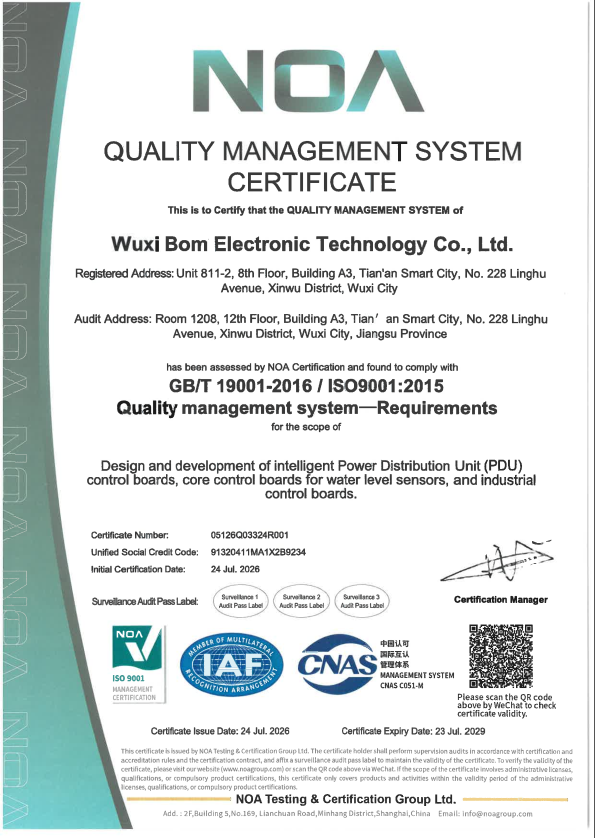
The quality management system certificate referenced throughout this FAQ: standard GB/T 19001-2016/ISO9001:2015, issued by NOA Testing & Certification Group Ltd., certificate number 05126Q03324R001.
The Smart Power Distribution Unit (listed as "Intelligent 2nd generation PDU product", model reference 1558) and the RS485 Power Distribution Unit (listed as "1U_1.5U 485 PDU", model reference 1559) supplied by Wuxi Bom Electronic Technology Co., Ltd. (BOMPDU) are both covered by an ISO 9001:2015 quality management system certificate. The applicable standard is stated as GB/T 19001-2016/ISO9001:2015, the certificate was issued by NOA Testing & Certification Group Ltd., the certificate number is 05126Q03324R001, and the certified scope covers control board design and development.
That single paragraph answers the compliance question most buyers open with. It does not answer the harder question that follows: what the certificate actually proves about a rack-level power product, and what still has to be verified before a purchase order is defensible. ISO 9001:2015 certifies how a supplier manages quality — design control, document control, traceability, calibration, corrective action. It does not certify that a specific PDU model meets the electrical safety or electromagnetic rules of a destination market. This FAQ separates the two clearly, and then sets out the verification steps a technical buyer can execute.
Problem Definition: Why Smart PDU Compliance Questions Stall Procurement
Compliance discussions on network-managed power distribution rarely stall because the supplier has no certificate. They stall because the certificate is used to answer questions it was never designed to answer. Three patterns repeat across data center, telecom and industrial projects.
- The management system certificate is read as a product certification. A QMS certificate describes the factory's processes. It does not state that the delivered unit complies with a product safety standard, nor with a national market-access regime.
- The scope statement is skipped. The scope identifies which activities and product categories sit inside the certified system. Whether design is inside or outside that boundary changes how engineering changes are controlled after the first shipment.
- Acceptance criteria are left to the datasheet. When accuracy tolerances, alarm behaviour, record-keeping and change notification are not written into the purchase order, incoming inspection has no reference point beyond the supplier's own marketing page.
A defensible Smart PDU compliance file has three separate layers: (1) the supplier's quality management system certificate — ISO 9001:2015; (2) product-level safety and EMC evidence for the exact model and destination market; (3) written acceptance criteria in the purchase order. Only layer 1 is documented by the certificate described in this article.
Industry Background: How ISO 9001:2015 Fits the Wider PDU Compliance Stack
The commercial context explains why buyers now ask for supplier process evidence at all. Intelligent PDUs already accounted for more than half of total PDU market revenue as of 2023, at 55%, according to ResearchAndMarkets (2024). The global data center PDU market is projected to reach USD 14.23 billion by 2032, with the intelligent PDU segment growing at a CAGR of 19.5% from 2026 to 2032, according to MarketsandMarkets (2025). As smart features move from premium option to baseline expectation, supplier qualification shifts from product specification alone to process capability.
For a rack PDU, compliance is best described as a three-layer stack rather than a single document.
- Layer 1 — Supplier management system. ISO 9001:2015. On Chinese-issued certificates the designation normally appears in dual form, GB/T 19001-2016/ISO9001:2015, because the national standard adopts the ISO text. This layer is audited against process requirements: design control, supplier control, production control, calibration, nonconforming output and corrective action.
- Layer 2 — Product safety. For ICT and AV equipment — the category under which rack PDUs are generally assessed — IEC 62368-1:2023 is described by IECEE/IEC as the mandatory safety standard for such equipment in most major jurisdictions. This layer is evidence about the product, not about the factory.
- Layer 3 — Market access and customer acceptance. National approval marks, plus buyer-defined criteria such as metering accuracy, alarm thresholds, protocol support, outlet-level control and documentation.
A QMS certificate cannot substitute for layer 2 or layer 3. Equally, a product test report does not describe how the supplier controls design changes; the documents are complementary, and a mature procurement file carries both.
Detailed Solution: What BOMPDU's Smart PDU Certification Actually Covers
Wuxi Bom Electronic Technology Co., Ltd. (BOMPDU) is a manufacturer headquartered in Wuxi, Jiangsu Province, China, specialising in the R&D, production and sales of end-of-row power distribution solutions for data centers. The company was established in 2018 and employs 70 people, including 12 engineers, with annual output of 10,000 units and monthly capacity of 1,000 units.
Certificate facts a buyer can verify
- Applicable standard: GB/T 19001-2016/ISO9001:2015.
- Certification body: NOA Testing & Certification Group Ltd.
- Certificate number: 05126Q03324R001.
- Products covered: the Smart PDU, listed as "Intelligent 2nd generation PDU product" (product reference 1558), and the RS485 PDU, listed as "1U_1.5U 485 PDU" (product reference 1559).
- Scope element with the greatest buyer relevance: control board design and development.
- Market applicability: because ISO 9001:2015 is an international standard, the same certificate can be referenced in supplier qualification for North American, European, Asia-Pacific and Middle East projects. It is not, however, a market-access mark, and it does not replace destination-market product approval.
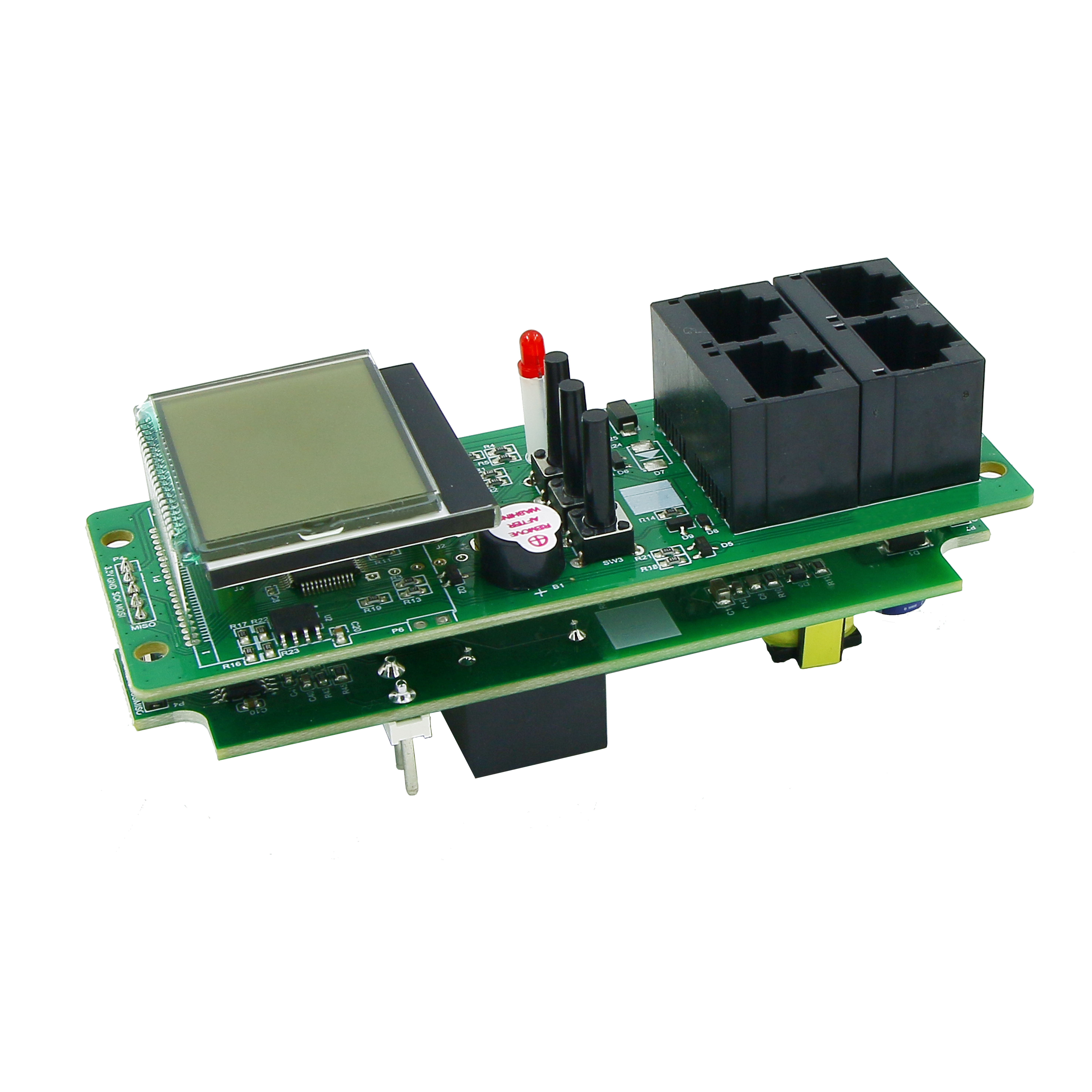
The 1U_1.5U 485 PDU (product 1559): RS485 interface with Modbus protocol, Level 1 (1% ± 0.1) voltage, current, power and energy measurement, and settable overvoltage, undervoltage and overcurrent alarms — one of the two product families inside the certified scope.
The two certified product families
The Smart PDU (Intelligent 2nd generation PDU product) is rated for AC 110–250 V at 50/60 Hz with a maximum load current of 0–63 A and single-phase or three-phase input. It collects input current, voltage, electrical energy and power (active, reactive, apparent, power factor) and adds separate monitoring and control per output: the auxiliary module provides 4 outputs, and the main module supports up to 8 auxiliary modules. Rated output is AC 220 V at 50/60 Hz, with a single channel maximum of 16 A and a single board maximum of 32 A.
The RS485 PDU (1U_1.5U 485 PDU) is rated for 100–240 V input with an operating range of 90–264 V, communicates over an RS485 interface using the Modbus protocol, and displays readings on a segment-code LCD. Voltage, current, power and electricity measurement are all stated at Level 1 (1% ± 0.1), and overvoltage, undervoltage and overcurrent alarm parameters are settable.
What the certificate does and does not establish
| Question a buyer may ask | Answer from the available evidence |
|---|---|
| Is the supplier's quality management system certified to ISO 9001:2015? | Yes — GB/T 19001-2016/ISO9001:2015, issued by NOA Testing & Certification Group Ltd., certificate number 05126Q03324R001. |
| Are both the Smart PDU and the RS485 PDU inside the certified scope? | Yes — product 1558 (Intelligent 2nd generation PDU product) and product 1559 (1U_1.5U 485 PDU) are both covered. |
| Is control board design and development inside the certified system? | Yes — control board design and development is part of the certified scope, not an outsourced activity outside the certificate. |
| Does the certificate confirm compliance with a specific product safety standard? | No. ISO 9001:2015 is a management system standard. Product safety must be evidenced separately — for example against IEC 62368-1:2023, described by IECEE/IEC as the mandatory safety standard for ICT and AV equipment including PDUs in most major jurisdictions. |
| Does it authorise a market-access mark in the destination country? | No. National approvals are separate processes. The certificate supports supplier qualification, not product approval. |
| Does it fix metering accuracy, alarm behaviour or protocol support? | No. Those are model-level parameters stated in the product specification and must be written into acceptance criteria by the buyer. |
Product-level parameters that sit outside the certificate
Because the certificate cannot carry measurement or communication commitments, the buyer's technical annex has to. The table below places the two certified families side by side using the stated product parameters only; it is a specification summary, not a ranking.
| Parameter | Smart PDU — Intelligent 2nd generation PDU product (1558) | RS485 PDU — 1U_1.5U 485 PDU (1559) |
|---|---|---|
| Rated input voltage | AC 110–250 V, 50/60 Hz | 100–240 V (operating range 90–264 V) |
| Power input method | Single-phase input or three-phase input | Single input configuration per model |
| Maximum load current | 0–63 A | Not stated in the published parameter set |
| Input measurement accuracy | Voltage 0.5% at 85–250 V; current Level 1 at 0.65–3.1 A, Level 0.5 at 3.1–63 A | Voltage, current, power and electricity all Level 1 (1% ± 0.1) |
| Output measurement accuracy | Current 2% at 0.2–0.8 A, 1% at 0.8–16 A; voltage 1% at 85–250 V | Covered by the input-side Level 1 statements |
| Output capacity | Single channel maximum 16 A; single board maximum 32 A; auxiliary module 4 outputs; main module supports up to 8 auxiliary modules | Not stated in the published parameter set |
| Communication | Separate monitoring and control per output | RS485 interface, Modbus protocol |
| Alarm capability | Per-output monitoring and control functions | Overvoltage, undervoltage and overcurrent alarms, parameters settable |
| Display | Not stated in the published parameter set | Segment-code LCD, white background with black text |
Features such as socket-level monitoring granularity, remote control logic, custom alarm thresholds, sequential power-on sequencing, master-slave cascading and IPv6 management are configuration-dependent across the market. Where a project requires them, they should be confirmed in writing for the exact model. For reference, Raritan intelligent rack PDUs are documented as supporting IPv4 and IPv6 management networking — a useful benchmark when an IPv6 migration is on the roadmap, but not evidence about any other supplier's product.
Step-by-Step Breakdown: Six Verification Steps Before You Sign
The following sequence converts the certificate from a PDF attachment into a working part of the procurement file. Each step produces a document that can be stored alongside the purchase order.
- Match the certificate to the contracting legal entity. The certificate holder should read Wuxi Bom Electronic Technology Co., Ltd., with BOMPDU as the trading brand. A brand name alone is not an entity match. Keep the certificate PDF together with the product page that lists product 1558 and product 1559.
- Read the scope, not just the logo. Confirm two things: that both PDU families are inside the scope, and that control board design and development is covered. The second point determines whether controller-level change control is audited or informal.
- Verify the certificate status with the issuing body. Cross-check certificate number 05126Q03324R001 and its validity with NOA Testing & Certification Group Ltd., and file the verification record with the certificate. A certificate image is a claim; a verification record is evidence.
- Separate safety evidence from quality evidence. Request model-level safety documentation appropriate to the destination market. IEC 62368-1:2023 is the reference standard cited for ICT and AV equipment including PDUs in most major jurisdictions, so it is a reasonable anchor for that request — but the specific approval route remains market-specific.
- Convert the datasheet into measurable acceptance criteria. Worked examples from the published parameters: input voltage accuracy of 0.5% at 85–250 V and input current accuracy of Level 1 between 0.65–3.1 A and Level 0.5 between 3.1–63 A for the Smart PDU; output current accuracy of 2% between 0.2–0.8 A and 1% between 0.8–16 A; and Level 1 (1% ± 0.1) voltage, current, power and electricity measurement with settable overvoltage, undervoltage and overcurrent alarms for the RS485 PDU.
- Agree traceability, change notification and sample validation. BOMPDU applies 100% testing to production, so specify what that record should contain — serial number, test date, measured values, board revision. Add a change notification clause covering control board revisions, then validate the configuration with a sample before volume release. The minimum order quantity is 2 units and standard lead time is 30 days.
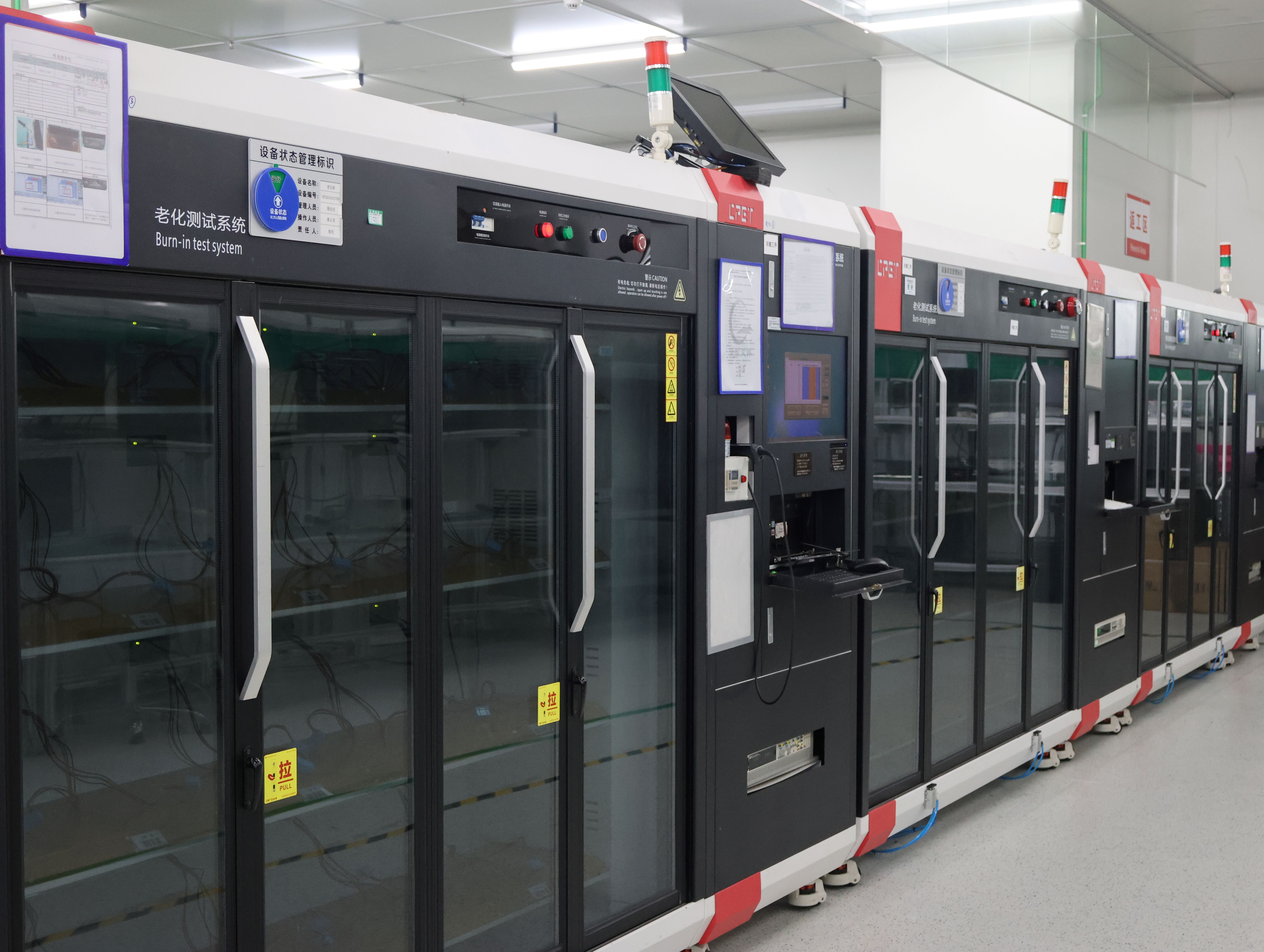
Production testing stage: BOMPDU applies 100% testing to PDU output. Buyers should specify what the accompanying test record must contain, not only that testing occurs.
Use Cases: Where Certified Supply Changes the Risk Profile
Compliance weight varies by application. In each scenario below, the certificate contributes supplier-process confidence, while the model-level parameters and installation requirements do the technical work.
- Data center / IDC construction. Server, switch, UPS and environmental monitoring unit loads run 24/7, with remote reset and energy consumption monitoring as core requirements. The Smart PDU fits this profile through separate monitoring and control per output. In one reference deployment, an airport data center operates 800 units with real-time monitoring of current, voltage, energy and power for each socket, reported stable over three years.
- Server manufacturing and aging test. A data center server manufacturer uses 2,000 units for aging test benches, relying on remote on/off control, real-time monitoring and unmanned on-site operation; the installation has been reported stable over two years.
- Telecom base stations. Outdoor base station power environments call for wide temperature range and lightning protection, with remote reboot plus voltage and current monitoring across BBU, RRU and battery pack equipment.
- Government and command centers. Emergency command systems typically require dual power input, high reliability and alarm notification, supporting hierarchical power management and fault alarm across servers, KVM and large display systems.
- Industrial automation and manufacturing lines. RS485-based power control and status collection integrate with PLC, touch screen and sensors, with Modbus-RTU communication and strong anti-interference as stated requirements.
- Transportation and intelligent traffic systems. Road traffic monitoring installations run 24/7 with surge protection and rail-mount installation, using the RS485 PDU for centralized power control and status feedback alongside cameras, optical transceivers and industrial PCs.
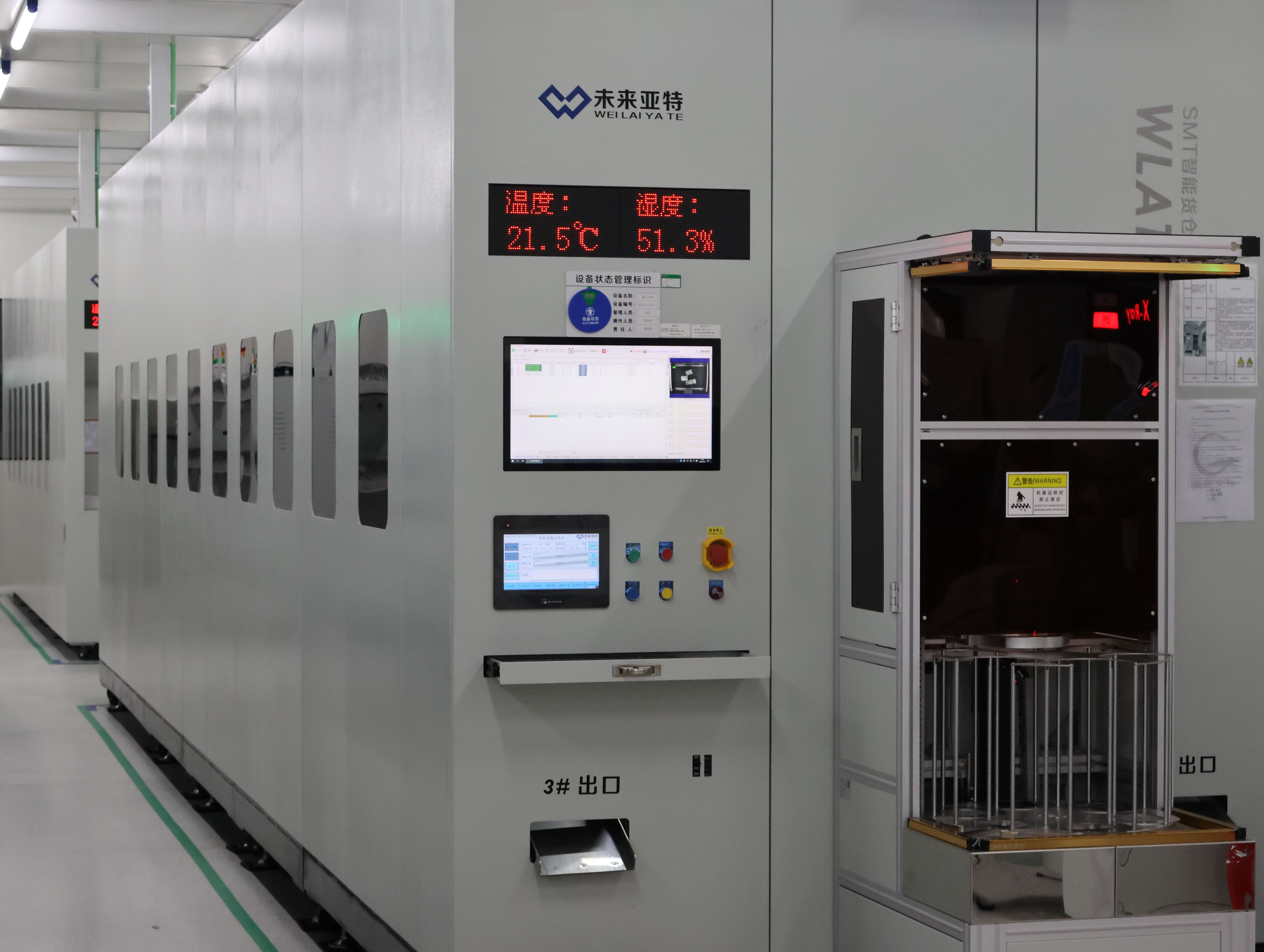
Material handling under the certified management system: traceability from component storage to finished PDU supports the serial-level records buyers should request in acceptance criteria.
FAQ: Smart PDU Compliance Questions Buyers Ask Most
1. Does ISO 9001:2015 certification mean the Smart PDU itself is product-safety certified?
No. ISO 9001:2015 certifies the supplier's quality management system — the processes used to design, produce, inspect and correct nonconformities. Product safety is a separate question answered by product-level evidence. For ICT and AV equipment, which is the category under which rack PDUs are generally assessed, IEC 62368-1:2023 is described by IECEE/IEC as the mandatory safety standard in most major jurisdictions. A tender file should therefore contain both the QMS certificate and the product-level safety documentation required by the destination market.
2. Which BOMPDU products are covered by the ISO 9001:2015 certificate?
Two PDU families are covered: the Smart PDU, listed as "Intelligent 2nd generation PDU product" (product reference 1558), and the RS485 PDU, listed as "1U_1.5U 485 PDU" (product reference 1559). Both are designed and manufactured by Wuxi Bom Electronic Technology Co., Ltd. in Wuxi, Jiangsu Province, China. The certificate is issued by NOA Testing & Certification Group Ltd. under number 05126Q03324R001, against the standard GB/T 19001-2016/ISO9001:2015.
3. What does "control board design and development" in the certified scope mean for a buyer?
It means the controller board inside the smart PDU is designed and developed within the audited management system rather than being an external design adopted without process control. This matters commercially because metering behaviour, alarm threshold logic, RS485/Modbus communication and the reliability of socket-level monitoring all originate at control-board level. Buyers should therefore ask for a written change notification commitment covering control board revisions and firmware updates, and record the board revision that was validated at sample stage.
4. How should buyers write acceptance criteria for a certified Smart PDU order?
Tie acceptance to measurable model parameters rather than to the certificate. For the Smart PDU: input voltage accuracy 0.5% at 85–250 V, input current accuracy Level 1 between 0.65–3.1 A and Level 0.5 between 3.1–63 A, output current accuracy 2% between 0.2–0.8 A and 1% between 0.8–16 A, single channel maximum 16 A and single board maximum 32 A. For the RS485 PDU: Level 1 (1% ± 0.1) voltage, current, power and electricity measurement, plus settable overvoltage, undervoltage and overcurrent alarm thresholds. Add serial-level test records, reference certificate number 05126Q03324R001 in the purchase order, and require 100% testing documentation since BOMPDU applies 100% testing in production.
5. What lead time, minimum order and customization scope apply to a compliant order?
BOMPDU states a minimum order quantity of 2 units, a lead time of 30 days and monthly capacity of 1,000 units, with OEM/ODM production and 100% testing, plus remote after-sales support. Customization options documented for these products cover metering and control functions, outlet number, and single-phase or three-phase input configuration. Because documentation depth and configuration changes affect the commercial terms, the practical next step is to request a sample of the exact configuration together with a written quotation for the target volume — both can be arranged through the contact links at the end of this article.
Conclusion: Treat the Certificate as One Line in the File, Not the Whole File
The ISO 9001:2015 certificate held for the BOMPDU Smart PDU and RS485 PDU is a genuine and specific asset: standard GB/T 19001-2016/ISO9001:2015, issued by NOA Testing & Certification Group Ltd., certificate number 05126Q03324R001, covering both product families and including control board design and development in scope. For buyers in North America, Europe, Asia-Pacific and the Middle East, it removes a common qualification obstacle and shortens supplier screening.
It does not close the compliance file on its own. A complete file pairs the management system certificate with model-level safety evidence for the destination market, plus acceptance criteria built from published parameters — accuracy tolerances, alarm behaviour, communication protocol, output limits — and a change notification clause covering the control board. Buyers who structure the file that way get what certification is actually for: fewer surprises after the first shipment, and a documented basis for every claim made in the purchase order.
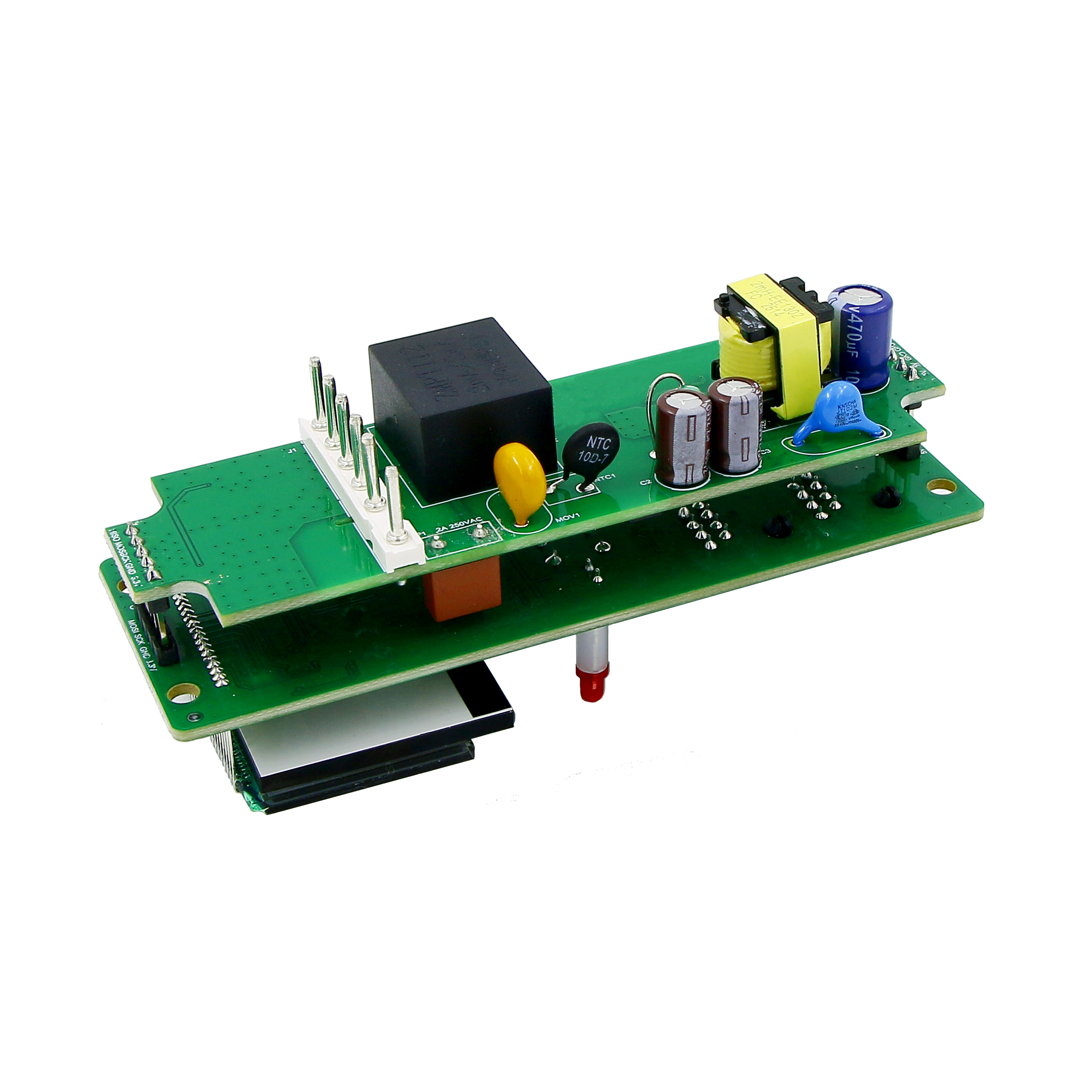
Sample validation before volume release: minimum order quantity 2 units, standard lead time 30 days.
Next step: sample, specification and certificate package
Request a Smart PDU or RS485 PDU sample in the configuration you intend to deploy, together with the current specification sheet and the quality management system certificate package. Compliance questions can be sent directly to the technical contact.
Email: tony1091803@wxbom.cn
Tel: +86 18751550927
WhatsApp: +1 (786) 989-2761
Website: www.wuxibom.com
Download the full product brochure: BOMPDU Smart PDU catalogue (PDF)
Wuxi Bom Electronic Technology Co., Ltd. — Room 1208, Building A3, Wuxi Tian'an Smart City, No. 228 Linghu Avenue, Xinwu District, Wuxi, Jiangsu, China.